
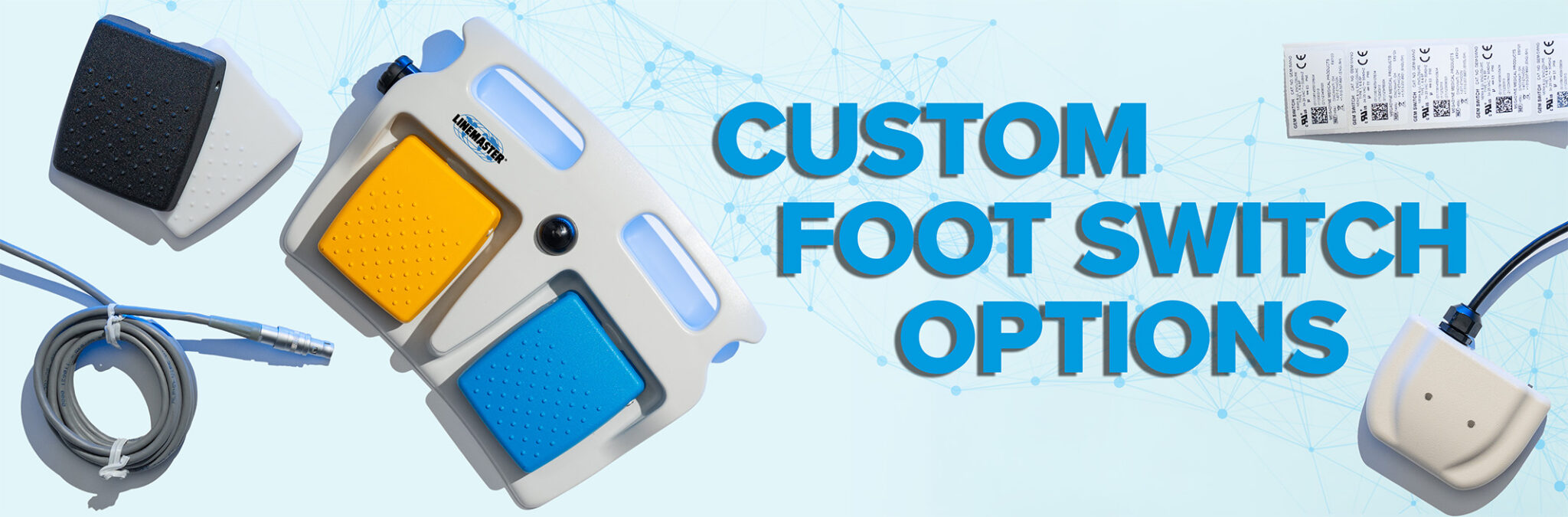
Custom Foot Switch Options OEM Engineers Can Build Around
Many OEM foot switch programs limit customization to cord lengths, connector changes, or cosmetic modifications. Critical design variables such as electrical architecture, redundancy strategy, tactile differentiation, wireless integration, and environmental sealing often remain fixed. That limitation forces equipment teams to adapt their systems around the control instead of integrating a control system designed around the equipment itself.
Linemaster’s OEM foot switch platforms are built to support deeper integration requirements across medical and industrial equipment programs. Electrical configuration, wireless communication architecture, redundancy systems, ergonomic layouts, housing construction, and environmental protection can all be configured around the operational, regulatory, and usability demands of the final device.
For OEM engineering teams, that flexibility reduces integration compromises early in development and allows foot control architecture to be evaluated as part of the overall equipment design rather than as a constrained downstream component selection.
This article outlines the primary customization paths available within a Linemaster OEM foot switch platform and how those options support real world equipment integration requirements.
Electrical Configuration: The Foundation of Every Custom Foot Switch
Electrical configuration defines how the foot switch interacts with the host equipment control system. Selecting the correct architecture early in development simplifies integration, reduces downstream redesign effort, and keeps the control logic aligned with the equipment’s operating requirements.
Supported contact configurations include:
Double Pole Single Throw (DPST)
Each configuration changes how the switch behaves within the circuit and how the equipment responds to operator input.
Momentary and maintained action options further define system behavior. Momentary switches remain active only while pressed, while maintained configurations stay engaged until reset by the operator or control system.
For additional background on switch architectures and circuit behavior:
Signal Architecture and Wireless Receiver Options
Additional information is available in:
Custom foot switch systems can be configured as either wired or wireless architectures depending on the equipment requirements, enclosure constraints, and operator workflow.
Wireless integration has become increasingly important for medical and laboratory equipment where cable management, mobility, and cleaning access directly affect usability and workflow efficiency.
Linemaster’s wireless platform uses 144 bit encryption, exceeding the 128 bit standard commonly used in wireless devices. The system incorporates:
- Perishable packets that expire after a single use
- Super encipherment using layered encryption methods
- Secure communication protocols designed for medical environments
For medical OEMs preparing FDA 510(k) submissions or internal cybersecurity documentation, wireless communication security becomes part of the overall system validation and risk management strategy.
Receiver architecture can also be configured around the equipment design. Available integration options include:
- NFC cradles
- USB dongles
- Serial communication modules
- Board level OEM receivers
This flexibility simplifies electrical integration and allows the receiver architecture to align with existing enclosure layouts, PCB constraints, and interface requirements.
Integrated LED indicators provide real time operator status feedback without requiring visual focus to shift away from the procedure or equipment interface.
Redundant Mechanical and Electrical Systems for Medical Foot Switches
In medical equipment, redundancy functions as a risk reduction strategy rather than a convenience feature. Mechanical and electrical redundancy can reduce single point failure exposure while improving long term system reliability and fault detection capability.
On the mechanical side, dual spring return systems provide actuator redundancy. The dual spring architecture maintains actuator return force even if one spring degrades over the product lifecycle.
Electrical redundancy configurations include:
- Dual channel sensing
- Paired Hall effect sensors
- Supervised circuits
These architectures improve fault detection while supporting OEM risk analysis, verification activities, and system reliability objectives.
The resulting control architecture aligns with ISO 14971 medical device risk management frameworks and supports Failure Modes and Effects Analysis activities during product development.
This article examines these strategies in greater detail.
Safety Mechanisms and
Tactile Design
Safety mechanisms should be configured around the operating environment
and operator workflow rather than treated as generic add on features.
Available protection options include:
- Anti trip mechanisms
- Adjustable actuation force
- Guards
- Gates
These features reduce accidental activation risk while improving operator control consistency and ergonomic performance.
For multi function medical equipment, tactile differentiation becomes equally important. Operators often rely on touch recognition while maintaining visual focus on the patient or surgical field.
OEMs can configure ergonomic layouts with:
- Twin pedal layouts using raised tactile dividers
- Three pedal layouts with color coded CUT, COAG, and FLUSH treadles
- Toe loops for hands free repositioning
These configurations improve operator differentiation between functions while supporting sterile workflow conditions and procedural efficiency.
The How Safety Mechanisms Prevent Accidental Activation On Foot Switches article explores these systems in more detail.
Housing Construction, Sealing, and Cleanability
Housing architecture can be configured around both environmental exposure requirements and equipment integration constraints.
PC/ABS sealed housings may be configured with independently sealed components, allowing push buttons and inputs to be positioned according to the equipment layout rather than fixed enclosure locations.
Modular treadle systems support multiple actuator configurations, including:
- Flip up treadles
- Linear treadles
- Alternative armature geometries
This modularity allows OEM teams to adapt the operator interface without redesigning the underlying platform architecture.
For medical equipment, enclosure durability extends beyond mechanical performance. The housing must also tolerate repeated exposure to aggressive hospital cleaning protocols and chemical disinfectants over the product lifecycle.
Linemaster performs in house validation testing against commonly used hospital disinfectants, including:
- Bleach based cleaners
- Glutaraldehyde solutions
- Isopropyl alcohol
- Saline solution
Ingress protection configurations can also be specified based on fluid exposure, cleaning requirements, and particulate conditions within the operating environment.

Additional information is available in:
Duty Ratings, Materials, and Cord Set Options
Duty rating selection should align with the actual operating environment, expected mechanical loading, and lifecycle requirements of the equipment.
Heavy duty foot switch platforms use reinforced housings, higher strength materials, and protective construction features designed for industrial operating conditions. Medium and light duty platforms support applications with lower environmental and mechanical demands.
Selecting the appropriate platform architecture early in development helps balance durability, integration requirements, manufacturability, and overall program cost.
Cord set configuration is also fully customizable. OEMs can specify:
- Cord length
- Jacket material
- Strain relief geometry
- Connector type
- Terminal configuration
These options allow the cable assembly to align with routing requirements, environmental exposure conditions, and equipment interface constraints.
The Cord Set Testing for Medical and Industrial OEM Applications article provides additional detail on testing protocols and available cable assembly configurations.
When a Custom Foot Switch Becomes a Special Build
A switch becomes a special build as soon as it deviates from a standard catalog configuration. That deviation may involve something minor, such as an extended cord length or customer specific labeling, or it may involve a fully customized electrical and mechanical architecture.
The definition remains intentionally broad because the platform is designed to support application specific requirements without forcing OEM teams into rigid catalog limitations.
For OEM engineering teams, evaluating foot switch architecture earlier in the equipment development cycle often reduces downstream integration compromises, validation complexity, and redesign risk.
Applications that extend beyond standard configurations can frequently be addressed through platform modifications before a fully custom architecture becomes necessary.
The What Makes a Switch Special article explains how custom and standard configurations are defined within the platform.
For applications requiring functionality beyond standard catalog offerings, Linemaster’s engineering team can evaluate platform modifications, subsystem integration requirements, and fully custom architectures to support the performance, usability, environmental, and regulatory demands of the final device.
Meet The Author

Arijan Kandic
Digital Marketing Specialist
Arijan is the Digital Marketing Specialist at Linemaster Switch Corporation and holds a bachelor’s degree in business management from Quinnipiac University. He manages the company’s SEO strategy, Google Ads campaigns, and digital marketing initiatives, and develops educational content for the Linemaster Learning Center to help engineers, OEMs, and medical device manufacturers better understand foot switch technology. Arijan works closely with Linemaster’s engineering and applications teams to translate complex technical concepts into clear, accurate articles on foot switch design, customization, and compliance considerations.
In Collaboration with

Sean Lewis
Director of Engineering
Sean has more than fifteen years of experience in product development, engineering governance, and cross functional technical operations. His background in metal fabrication, including machining, forming, welding, and inspection, provides a strong manufacturing foundation that supports his approach to design and process optimization. Sean holds a bachelor’s degree in mechanical engineering, an MBA with a manufacturing concentration, and an MSOL. He is a Certified SolidWorks Expert with advanced capability in CAD, rendering, simulation, and rapid prototyping. Sean also specializes in DFMEA and PFMEA risk management practices and is the holder of several foot switch design and utility patents.
Uploaded 05/14/2026
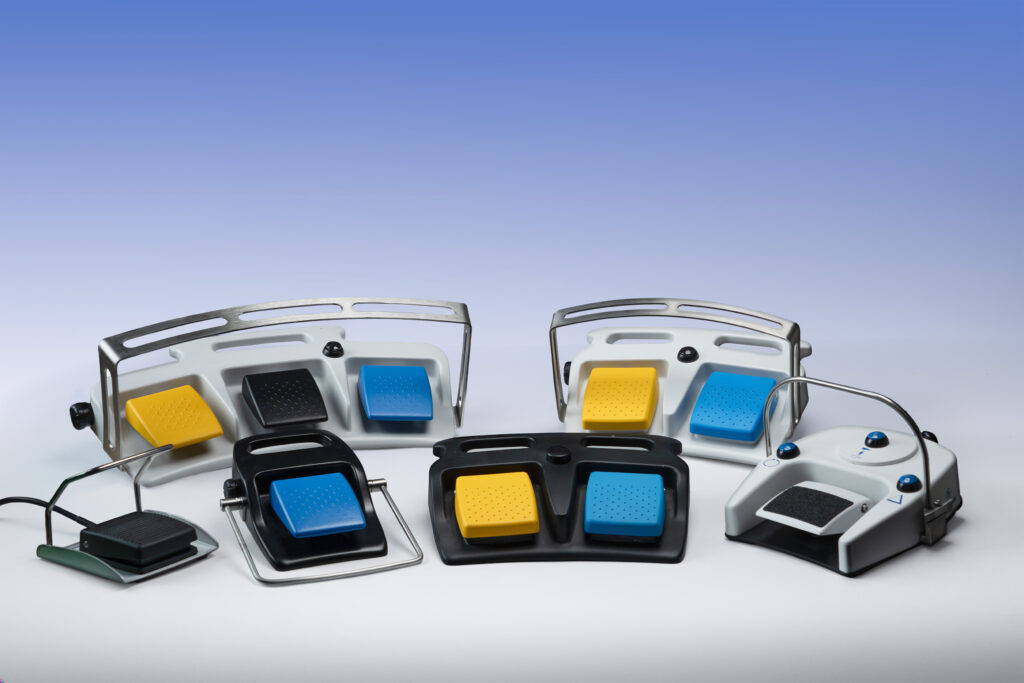
Custom Foot Switches
Linemaster’s custom footswitches are designed to meet specific user requirements, offering a range of features such as various pedal configurations, wired and wireless options, and customizable LED indicators. These custom footswitches provide reliable, durable solutions tailored to enhance functionality in diverse applications.

