
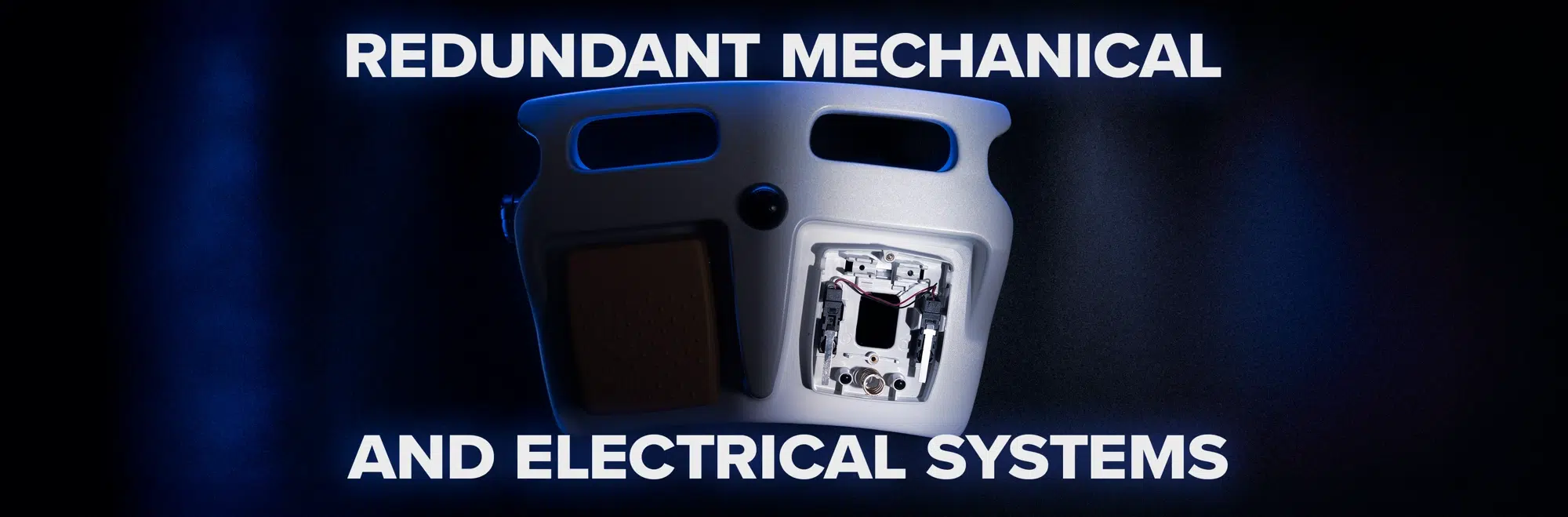
Redundant Mechanical and Electrical Systems in Medical Foot Controls
In medical environments, medical foot switches and hand controls act as critical interface devices, where consistent and predictable performance is expected through repeated use. From a risk management standpoint, redundancy is intentionally built into the design to help reduce overall risk by lowering the chance of failure and improving the ability to detect issues.
For accessory devices like foot and hand controls, Severity is largely determined by the larger medical system they are a part of. Because of this, the focus at the control level is placed on reducing occurrence and improving detection, while supporting how the overall system handles severity through its response.
Redundancy is not just about improving reliability. It is a structured way to reduce single point failures, maintain proper function, and allow issues to be identified early, all within defined system safety requirements.
The approaches outlined here reflect common ways redundancy is used in practice. They are not meant to cover every possible method but instead highlight typical design strategies used in medical foot and hand controls.
Mechanical Redundancy in Control Devices
Mechanical redundancy is often built directly into the actuation mechanism. One common method is the use of dual spring systems.
In this setup, both springs work together to provide the force needed to return the control after it is pressed. If one spring weakens or fails due to fatigue or damage, the second spring is still able to provide enough force to return the control to its original position.
This reduces the risk of a total loss of function by removing a single point of failure and allowing the system to continue operating, even in a degraded state. In a failure modes and effects analysis (FMEA), this directly contributes to lowering occurrence.


Electrical Redundancy and Dual Channel Sensing
Electrical redundancy focuses on maintaining accurate signal detection while also making it easier to identify faults. This is typically done by introducing multiple sensing elements into the design.
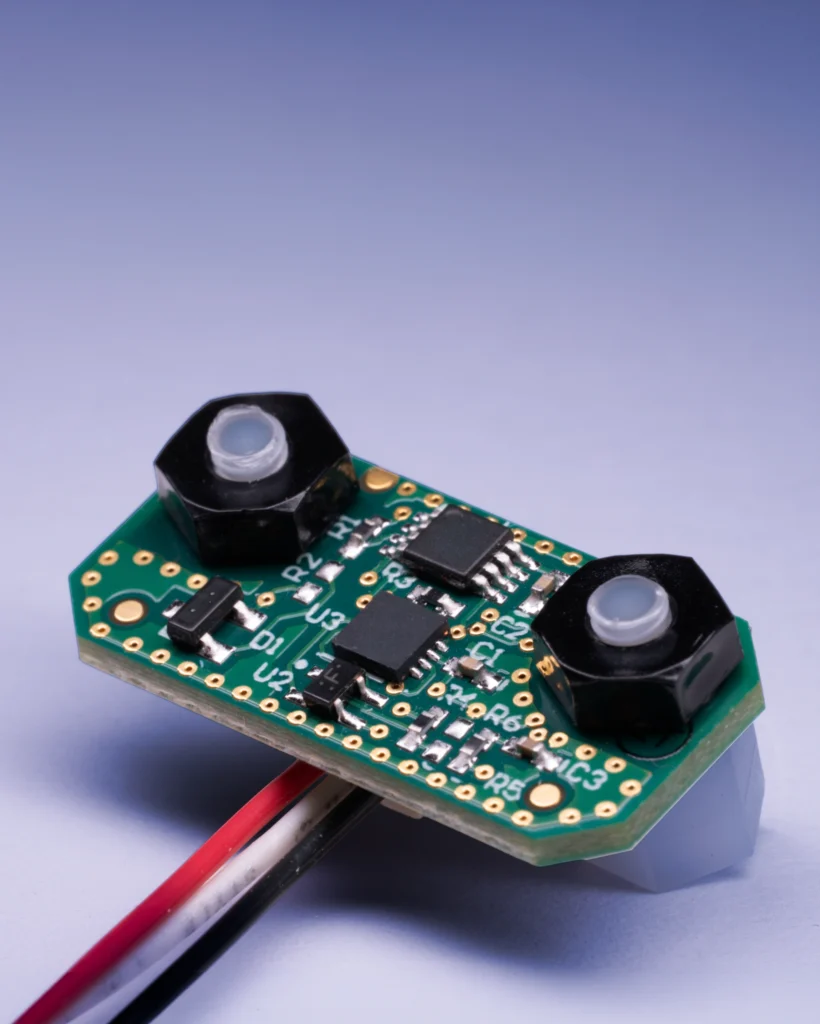
Systems may use dual microswitches, dual Hall effect sensors, or a combination of mechanical and non-contact sensing technologies. These elements are often set up in dual-channel sensing configurations, where independent signal paths run in parallel.
By comparing outputs between channels, the system can confirm proper operation and detect differences that indicate a fault. This improves detection by increasing the likelihood that issues are identified before they lead to unintended system behavior.
Fault Detection and System Response
In systems that use dual Hall effect sensors, both sensors independently measure the magnetic field based on the position of the control. Their outputs are continuously monitored and compared within defined limits.
If the signals fall outside of acceptable ranges, the system can recognize a fault condition in real time. This continuous comparison strengthens detection by allowing problems like sensor drift, signal loss, or calibration issues to be identified early, before they affect higher-level system performance.
Beyond sensing, many designs also include supervised circuits to confirm overall system integrity. These circuits continuously check for issues such as open connections, short circuits, or unintended interference.
Methods like end of line resistors are used to verify that the circuit remains complete, while watchdog signals help confirm that the system is still active and functioning as expected.
When a fault is detected, the response is handled by the host system. Depending on the application, this may involve sending an error signal to the console, disabling the control output, requiring a system reset, or allowing the system to directly evaluate the incoming data.
While these features help ensure safe behavior, the actual severity of any situation is still determined by the overall system or device.

Redundancy in Medical Device Risk Management
These redundancy strategies are not used on their own. Medical foot and hand controls are designed as part of a larger framework aligned with ISO 14971 risk management.
Within this framework, redundancy is primarily used to reduce occurrence by eliminating single point failures and to improve detection through continuous monitoring and diagnostics. The overall system then defines how severity is handled.
These design decisions are formally documented in a Failure Modes and Effects Analysis. Within an FMEA, redundancy and diagnostic features are evaluated as risk reduction measures that lower the likelihood of failure and improve detection of potential issues.
This creates a clear connection between the design itself and the documented risk controls.
Final Thoughts
Redundant mechanical and electrical systems are more than just design features. They are essential parts of medical device risk control.
By combining redundancy with diagnostic capabilities, these systems are built to continue operating under partial failure conditions, identify issues before they lead to hazardous outcomes, and function effectively within larger system safety structures.
While the examples covered here represent common approaches, they are only part of what is possible. Redundancy can be applied at different levels depending on the application, risk profile, and regulatory requirements.
The goal remains the same: reduce risk by improving occurrence and detection, while supporting safe system behavior defined by the overall medical device.
These design approaches ultimately support broader medical device risk management strategies by reducing risk through improved detection and lower likelihood of failure.
Explore our full medical foot control safety features page to see how redundancy, fault detection, and other design elements come together in real-world applications.
Frequently Asked Question
What is redundant sensing and why is it a safety requirement in surgical foot controls?
Redundant sensing means more than one element reads the same pedal action, often through dual microswitches, dual Hall effect sensors, or a mix of mechanical and non-contact sensing. The signals run on independent channels, and comparing them lets the system confirm proper operation or flag a mismatch as a fault. In surgical foot controls, that matters because redundancy lowers the chance of a single point failure and helps issues surface early, both of which support the broader safety framework the foot control sits within.
Meet The Author

Arijan Kandic
Digital Marketing Specialist
Arijan is the Digital Marketing Specialist at Linemaster Switch Corporation and holds a bachelor’s degree in business management from Quinnipiac University. He manages the company’s SEO strategy, Google Ads campaigns, and digital marketing initiatives, and develops educational content for the Linemaster Learning Center to help engineers, OEMs, and medical device manufacturers better understand foot switch technology. Arijan works closely with Linemaster’s engineering and applications teams to translate complex technical concepts into clear, accurate articles on foot switch design, customization, and compliance considerations.
In Collaboration with

Sean Lewis
Director of Engineering
Sean has more than fifteen years of experience in product development, engineering governance, and cross functional technical operations. His background in metal fabrication, including machining, forming, welding, and inspection, provides a strong manufacturing foundation that supports his approach to design and process optimization. Sean holds a bachelor’s degree in mechanical engineering, an MBA with a manufacturing concentration, and an MSOL. He is a Certified SolidWorks Expert with advanced capability in CAD, rendering, simulation, and rapid prototyping. Sean also specializes in DFMEA and PFMEA risk management practices and is the holder of several foot switch design and utility patents.
Uploaded 04/22/2026
Custom Foot Switches
Linemaster’s custom footswitches are designed to meet specific user requirements, offering a range of features such as various pedal configurations, wired and wireless options, and customizable LED indicators. These custom footswitches provide reliable, durable solutions tailored to enhance functionality in diverse applications.

