

Aero Channel Medical Foot Switch: A More Adaptable Approach to Channel Design
Medical foot controls continue to evolve as OEM requirements become more specific around cleanability, usability, and system integration. The Aero Channel medical foot switch was developed to address these needs by refining the traditional channel style design into a more compact, flexible, and configurable platform.
Earlier channel designs often introduced challenges related to size and usability. Larger footprints could limit installation in tighter environments, while sealed internal construction could restrict where components, such as push buttons, can be placed. In some cases, fluid accumulation within the channel also made cleaning more difficult.
The Aero Channel was designed to improve on these limitations without overcomplicating the system. By reducing overall size and reworking the internal layout, the platform supports more flexible deployment across a wider range of medical applications.
The Aero Channel was designed to improve on these limitations without overcomplicating the system. By reducing overall size and reworking the internal layout, the platform supports more flexible deployment across a wider range of medical applications.
One of the most noticeable improvements is in the surface design. The housing uses a continuous molded structure that wraps under the pedal and down to the baseplate, removing gaps where fluid could collect. Internal surfaces are tapered to help direct fluids outward, reducing the likelihood of buildup inside the channel. For applications that require deeper access during cleaning, flip-up treadle configurations allow full access beneath the pedal.
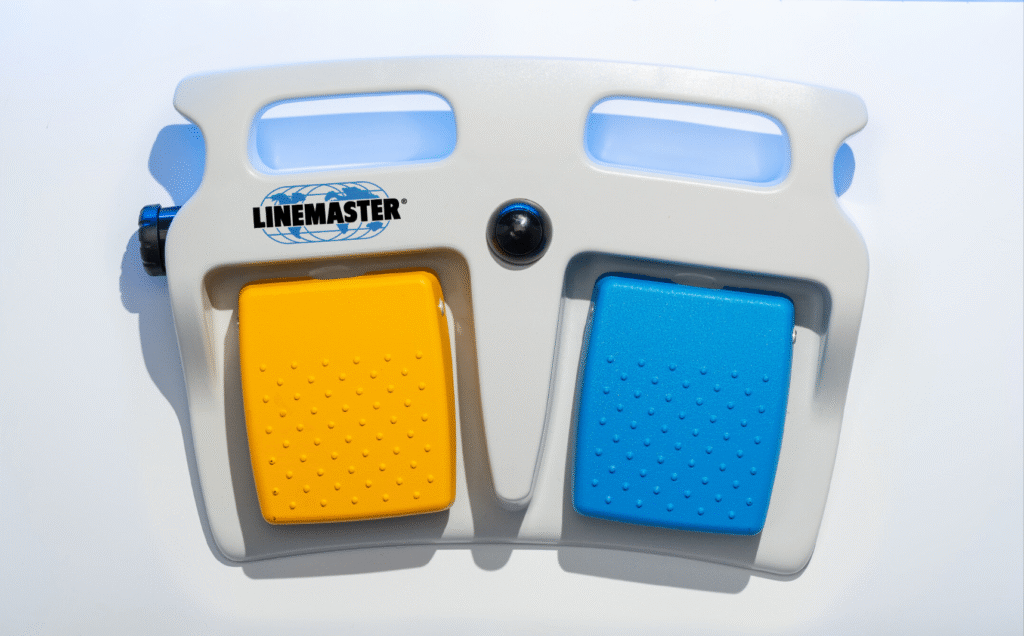
From a usability standpoint, the Aero Channel offers a broader range of pedal access, allowing operators to engage the control from multiple angles. Channel dividers and surface textures provide tactile reference points, helping guide foot placement without requiring visual confirmation.
Internally, the design shifts towards independently sealed components. This allows push buttons to be placed more freely across the housing rather than being limited to fixed locations. It also supports more flexible system layouts, especially in applications where control inputs need to be customized.
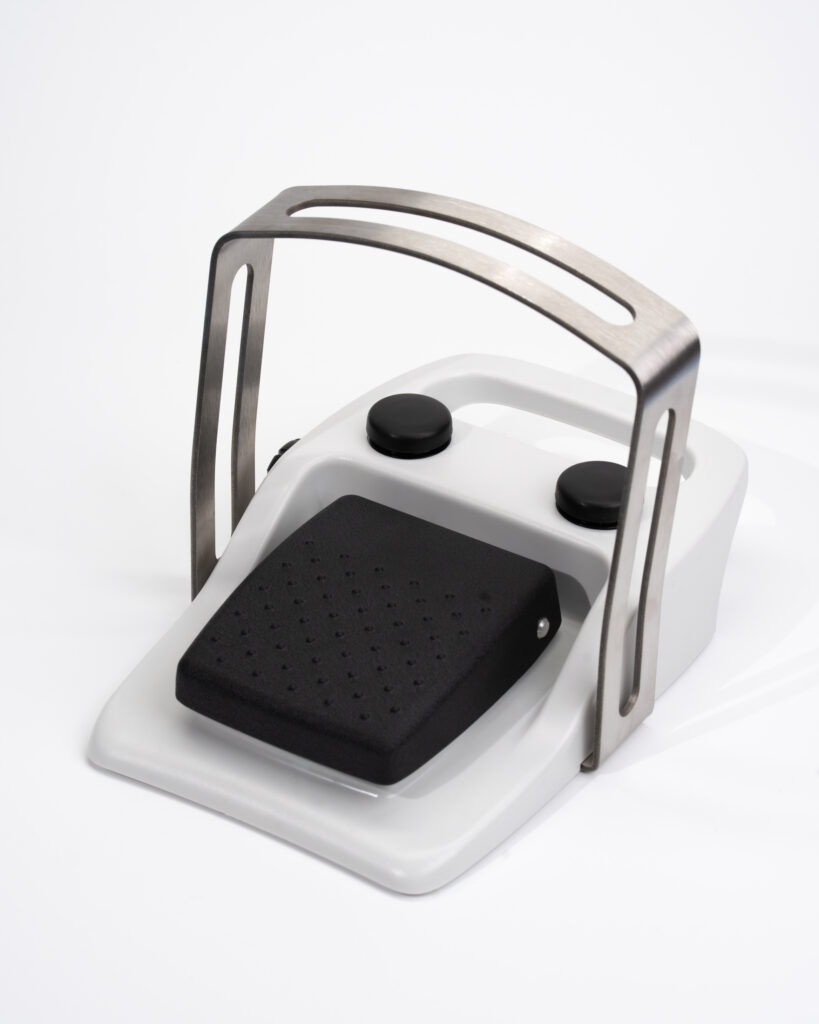
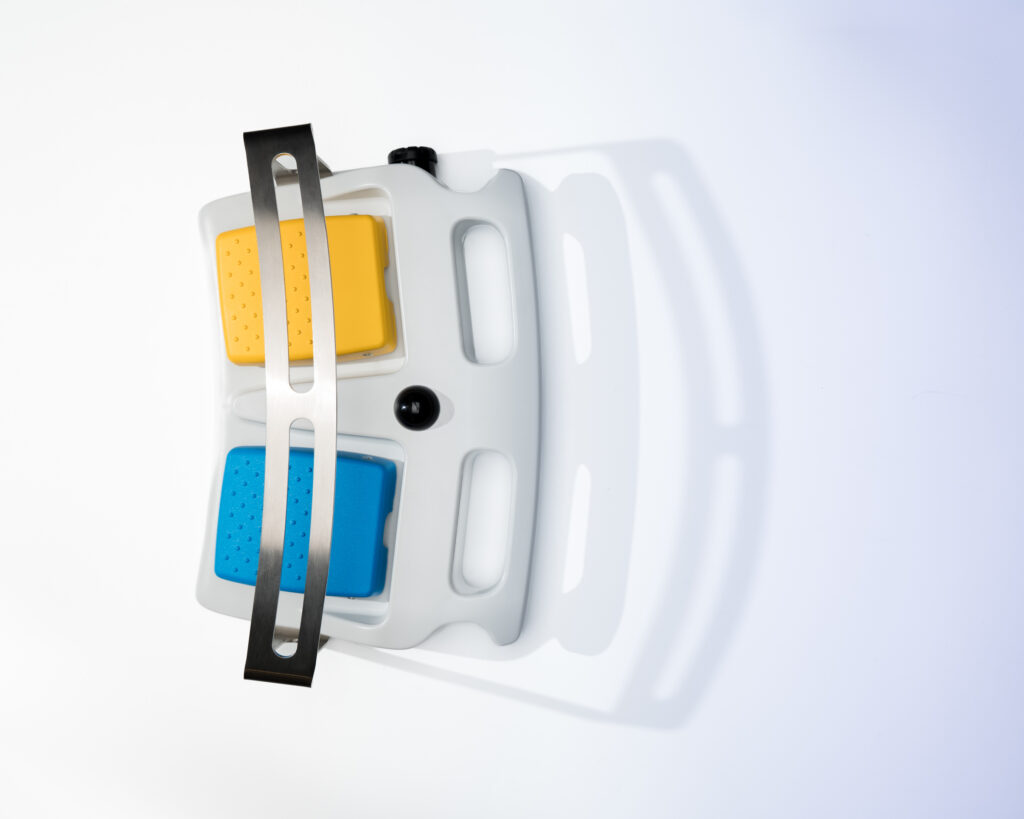
The modular treadle system is another key feature. Instead of a fixed configuration, the channel section can be swapped with different armatures, such as flip-up or linear designs. This makes it easier to adapt the same base platform to different control requirements without redesigning the entire unit.
Material options include PC/ABS for a balance of durability and weight, as well as aluminum and stainless-steel variants for more demanding environments. Footing options and surface finishes can also be adjusted to improve stability depending on the application.
From a control perspective, the Aero Channel supports a range of configurations. These include single-stage and multi-stage microswitch setups, as well as Hall-effect and hybrid sensing options. Linear configurations are also available for applications that require variable output and more precise control.
Customization plays a major role in how the platform is used. Push buttons can vary in size, placement, and actuation force. Surface labeling, color coding, and artwork can be applied through pad printing or inkjet methods. Wireless pairing options can also be configured in multiple ways depending on system requirements.
Overall, the Aero Channel offers a more adaptable approach to channel-style foot switch designs. By focusing on cleanability, modularity, and configuration flexibility, it supports a wide range of medical applications without introducing unnecessary complexity.
Meet The Author

Arijan Kandic
Digital Marketing Specialist
Arijan is the Digital Marketing Specialist at Linemaster Switch Corporation and holds a bachelor’s degree in business management from Quinnipiac University. He manages the company’s SEO strategy, Google Ads campaigns, and digital marketing initiatives, and develops educational content for the Linemaster Learning Center to help engineers, OEMs, and medical device manufacturers better understand foot switch technology. Arijan works closely with Linemaster’s engineering and applications teams to translate complex technical concepts into clear, accurate articles on foot switch design, customization, and compliance considerations.
In Collaboration with

Sean Lewis
Director of Engineering
Sean has more than fifteen years of experience in product development, engineering governance, and cross functional technical operations. His background in metal fabrication, including machining, forming, welding, and inspection, provides a strong manufacturing foundation that supports his approach to design and process optimization. Sean holds a bachelor’s degree in mechanical engineering, an MBA with a manufacturing concentration, and an MSOL. He is a Certified SolidWorks Expert with advanced capability in CAD, rendering, simulation, and rapid prototyping. Sean also specializes in DFMEA and PFMEA risk management practices and is the holder of several foot switch design and utility patents.
Uploaded 03/18/2026
Custom Foot Switches
Linemaster’s custom footswitches are designed to meet specific user requirements, offering a range of features such as various pedal configurations, wired and wireless options, and customizable LED indicators. These custom footswitches provide reliable, durable solutions tailored to enhance functionality in diverse applications.

