
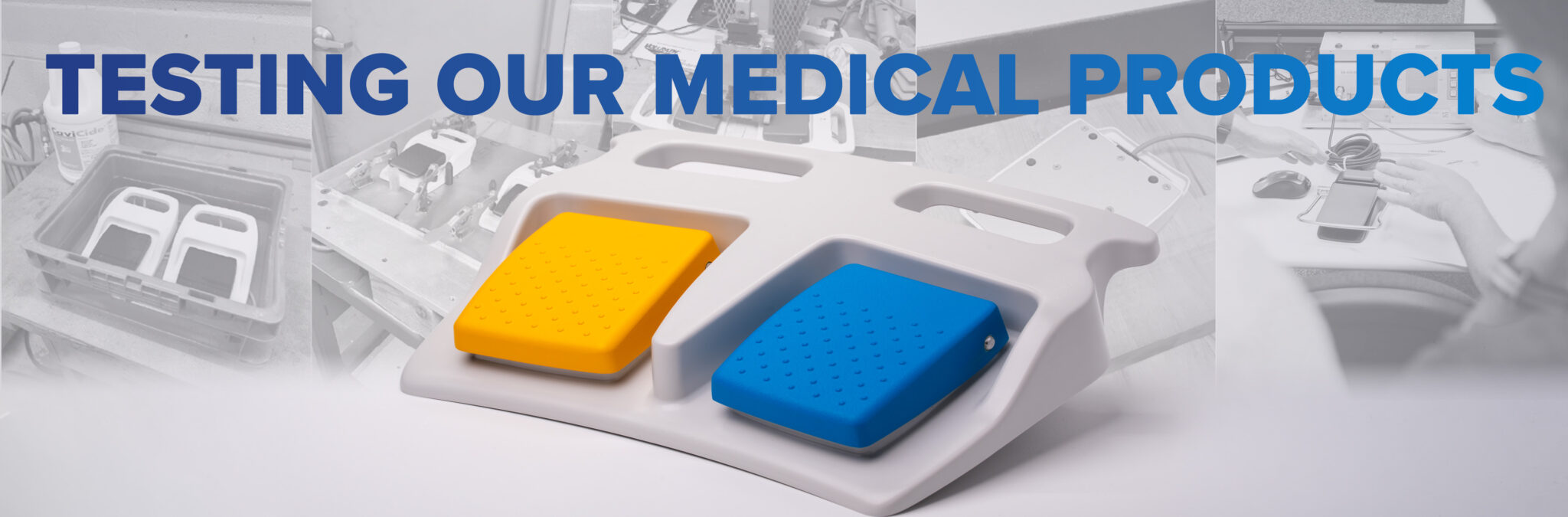
What Testing Has Been Done on Our Medical Products
Reliability is crucial in medical environments. Medical foot switches are used constantly and are exposed to cleaning agents, fluids, and repeated handling. Over time, these conditions can affect their performance. That’s why medical product testing is part of the development process from the start.
Testing isn’t a one-time step done at the end of production. It usually begins early in the design phase and continues as the product moves toward validation. Internal evaluations help identify potential issues before formal submission, while accredited third-party testing provides the documentation required for regulatory compliance.
Understanding how these stages collaborate clarifies what testing is required and how medical foot switches are prepared for real-world application.
Why Testing Matters for Medical Foot Switches
In healthcare settings, foot switches may be used thousands of times and regularly cleaned with disinfectants. These conditions are typical of normal use. Testing in simulated real-world scenarios helps engineering teams observe how materials, seals, and internal electrical parts hold up over time.
Testing protocols are typically aligned with documented risk assessments so that evaluation efforts focus on potential failure modes that could affect safety, usability, or long-term reliability.
Identifying potential weaknesses early allows for adjustments before the product undergoes formal validation. Including testing during development helps ensure more reliable long-term performance in demanding medical settings.

In-House Testing During Foot Switch Development
In-house testing is usually performed early in the design phase to better understand how a medical foot switch might function under typical use conditions. This can include drop testing, vibration testing, environmental testing, high-cycle activation testing, and exposure to chemicals with common medical cleaning agents.
Based on the set of functional, environmental, and regulatory requirements defined by the OEM, a structured Design of Experiments is often developed to systematically evaluate critical variables. This approach allows engineering teams to control, measure, and analyze the interaction of key factors such as load, cycle rate, environmental exposure, and material performance. By aligning the experimental framework directly with OEM specifications, testing becomes both data driven and application specific.
These assessments allow for the review of materials, construction techniques, and sealing methods in a controlled setting. If issues emerge, adjustments can often be made more efficiently at this stage.
It is crucial to understand that in-house testing does not replace certified third-party testing. Linemaster is not an accredited testing laboratory. Formal compliance checks are carried out by external, certified facilities when needed.
By conducting structured pre-testing first, potential issues can be identified earlier in the development process. This helps prepare the product for formal evaluation and decreases the chances of unnecessary retesting.


Internal Testing Referencing IEC 60601 Conditions
For specific medical applications, internal evaluations may refer to conditions outlined in established standards, such as IEC 60601 for medical electrical equipment.
Although formal IEC testing is performed by accredited laboratories, internal testing can be organized to mimic similar stress conditions. Drop testing may be conducted from specific heights onto designated surfaces. Vibration testing can assess how internal components respond to movement. Extended life-cycle testing might evaluate electrical and mechanical reliability through repeated activations. Chemical resistance testing could determine how exposure to disinfectants affects materials and performance.
Referring to these conditions internally does not imply certification. These evaluations are designed to simulate real-world stress and help prepare the switch for formal third-party testing.
External Third-Party Product Testing
When needed for medical device applications, formal compliance testing is performed by accredited third-party laboratories. These evaluations may include electrical safety testing and other regulatory assessments, depending on the device and application.
Unlike internal pre-testing, third-party certification offers documented proof that a product complies with applicable standards. These reports can support OEM design verification activities and regulatory submissions within their quality management system.
Internal testing and third-party testing serve different purposes. Pre-testing prepares the product, while accredited testing provides formal validation.
Medical Product Testing Conclusion
Testing medical foot switches involves multiple layers. It starts with an internal assessment and proceeds to certified third-party validation.
Pre-testing helps detect potential issues early and prepares the product for formal submission. Accredited laboratory testing then supplies the documentation needed for regulatory compliance.
This structured approach supports predictable verification outcomes, reduces regulatory risk, and improves long-term performance reliability in medical environments.
Meet The Author

Arijan Kandic
Digital Marketing Specialist
Arijan is the Digital Marketing Specialist at Linemaster Switch Corporation and holds a bachelor’s degree in business management from Quinnipiac University. He manages the company’s SEO strategy, Google Ads campaigns, and digital marketing initiatives, and develops educational content for the Linemaster Learning Center to help engineers, OEMs, and medical device manufacturers better understand foot switch technology. Arijan works closely with Linemaster’s engineering and applications teams to translate complex technical concepts into clear, accurate articles on foot switch design, customization, and compliance considerations.
In Collaboration with

Sean Lewis
Director of Engineering
Sean has more than fifteen years of experience in product development, engineering governance, and cross functional technical operations. His background in metal fabrication, including machining, forming, welding, and inspection, provides a strong manufacturing foundation that supports his approach to design and process optimization. Sean holds a bachelor’s degree in mechanical engineering, an MBA with a manufacturing concentration, and an MSOL. He is a Certified SolidWorks Expert with advanced capability in CAD, rendering, simulation, and rapid prototyping. Sean also specializes in DFMEA and PFMEA risk management practices and is the holder of several foot switch design and utility patents.
Uploaded 03/06/2026
Custom Foot Switches
Linemaster’s custom footswitches are designed to meet specific user requirements, offering a range of features such as various pedal configurations, wired and wireless options, and customizable LED indicators. These custom footswitches provide reliable, durable solutions tailored to enhance functionality in diverse applications.

