
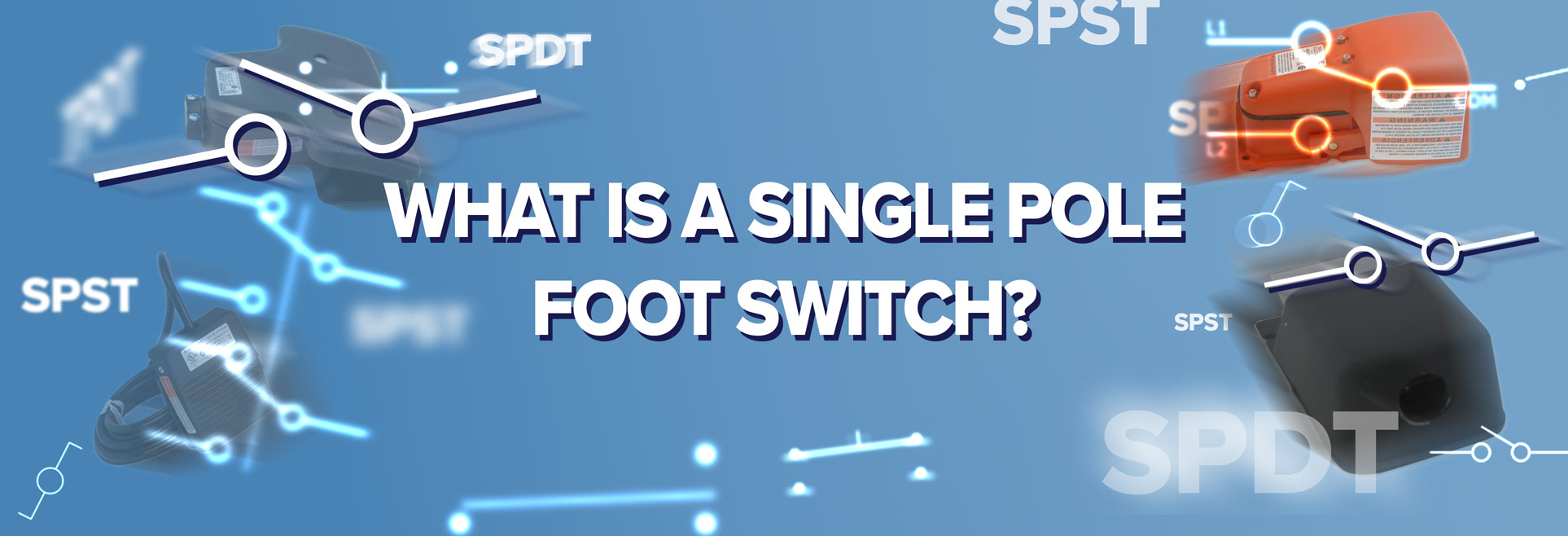
What Is a Single Pole Switch?
When an operator presses a foot control to activate a medical device or start industrial equipment, a simple electrical action occurs behind the scenes. A circuit is either completed or interrupted.
In many systems, that function is handled by a single pole switch.
A single pole switch is one of the most widely used switch configurations in electrical control. It is designed to open or close one electrical circuit using a straightforward ON and OFF mechanism.
Because of its simplicity and reliability, the single pole configuration appears in a wide range of electrical devices, including industrial machinery, medical equipment, and foot operated controls.
How Does a Single Pole Switch Work?
To understand how a single pole switch works, it helps to clarify what the term pole means.
A pole refers to the number of separate circuits a switch controls. A single pole switch controls one circuit path.
When the switch is actuated, its internal contacts either complete the circuit, allowing current to flow, or interrupt the circuit, stopping the flow of electricity.
In its simplest form, this configuration is known as a single pole single throw (SPST) switch. An SPST switch provides a single input and a single output, providing a basic ON and OFF function.
Another common variation is the single pole double throw (SPDT) switch. An SPDT switch still controls one circuit, but it can route that circuit to one of two possible outputs.
Instead of only turning a circuit on or off, it allows the electrical path to be redirected between two connections.

Understanding the difference between pole and throw is important when comparing switch designs. For a deeper explanation of these configurations, see our guide to SPST, SPDT, DPST, and DPDT switches:
Contact behavior can also vary. A single pole switch may be normally open, meaning the circuit remains open until the switch is pressed, or normally closed, meaning the circuit remains closed until the switch is pressed.
It may also be momentary, returning to its default position when released, or maintained, remaining in position until actuated again. If you would like to explore these switch behaviors in more detail, see our article on momentary vs maintained switches:
Regardless of configuration, the defining characteristic remains the same. A single pole switch controls one circuit.

What Is a Single Pole Switch Used For?
A single pole switch is used in applications where only one electrical circuit needs to be controlled.
In industrial environments, this may include activating a machine function, enabling a motor, or switching a control signal.
In medical equipment, a single pole foot switch may control imaging adjustments, power a device function, or trigger a specific operational response.
Foot operated controls are especially useful when operators need to keep their hands free while controlling equipment. For a broader overview of how foot controls are used in equipment design, see our Complete Guide to Foot Switches:
Single pole switches are commonly used in single stage foot switch designs, where one pedal movement activates one electrical function. To learn more about these configurations, see Understanding Foot Switch Stages:
Because it controls only one circuit path, a single pole switch is often appropriate in systems where complete disconnection of multiple conductors is not required. It is commonly used for signal level switching, moderate load control, and applications where predictable ON and OFF behavior is essential.
Its straightforward operation makes it a practical solution when simplicity and reliability are priorities.
Components of a Single Pole Switch
The core components of a single pole switch are centered on its contact system and actuator mechanism.
Internally, electrical contacts open or close the circuit path. These contacts are rated for specific voltage and current levels, which determine the electrical loads the switch can control. Proper selection depends on matching the switch rating to application requirements.
Externally, the actuator allows the user to operate the switch. In foot control designs, this may take the form of a treadle or a pedal. In other equipment, it may be a toggle, pushbutton, or rocker style actuator.
If you are unfamiliar with foot operated control, take a look through the other blogs in our Learning Center for a deeper look at how foot operated controls work, where they are used, and the different designs available.
While enclosure design, sealing, and mechanical construction may vary by environment, the internal purpose remains consistent. Open or close one electrical circuit reliably.

Advantages of a Single Pole Switch
The primary advantage of a single pole switch is its simplicity.
Because it controls only one circuit, it can be easier to integrate into equipment designs and easier to understand during troubleshooting. The straightforward configuration simplifies the system when multiple switching paths are not required.
Single pole switches are available in a wide range of electrical ratings and environmental conditions. Depending on the design, they may be suitable for controlled environments or more demanding industrial settings that require durability and environmental protection.
When an application requires control of a single circuit path, a single pole switch often provides an efficient and practical solution.

Limitations of a Single Pole Switch
A single pole switch is not suitable for every application.
Because it interrupts only one circuit, it does not provide simultaneous control of multiple conductors.
In certain systems, such as 240 volt configurations where both conductors are energized, both lines may need to be switched simultaneously. In those cases, a double pole switch may be required.
A single pole switch also does not inherently provide redundant or independent switching paths. If an application requires two separate circuits to change state together for safety or compliance reasons, a different configuration should be considered.
Understanding these limitations helps ensure the selected switch configuration aligns with the equipment’s electrical and functional requirements.
Choosing the Right Single Pole Switch for Your Application
A single pole switch remains one of the most common and practical switching configurations in electrical control systems. Its simplicity, flexibility, and broad range of available ratings make it suitable for many industrial and medical applications.
Selecting the appropriate configuration requires evaluating the electrical load, environmental conditions, and whether additional circuit isolation or multiple switch paths are necessary.
If you are evaluating a single pole switch for your equipment, reviewing technical specifications and comparing configurations can help ensure the switch aligns with your design requirements.

Frequently Asked Questions
Are single pole foot switches only for dry, clean environments?
Environmental suitability depends on the switch’s specific design and construction. Some single pole foot switches are intended for controlled environments, while others are built to withstand more demanding industrial conditions. Reviewing the product specifications for sealing and environmental ratings is recommended.
What ratings matter most on a single pole switch in real equipment?
Voltage and current ratings are critical because they determine the electrical load a switch can handle. In motor driven applications, horsepower ratings may also be relevant. The appropriate rating depends on the equipment’s electrical characteristics.
Can an SPDT switch be used as a single pole ON and OFF switch?
Yes. An SPDT switch still controls one circuit. If only one output path is used, it can function as a basic ON and OFF switch. The key distinction is that it allows the circuit to connect to one of two outputs.
Meet The Author

Arijan Kandic
Digital Marketing Specialist
Arijan is the Digital Marketing Specialist at Linemaster Switch Corporation and holds a bachelor’s degree in business management from Quinnipiac University. He manages the company’s SEO strategy, Google Ads campaigns, and digital marketing initiatives, and develops educational content for the Linemaster Learning Center to help engineers, OEMs, and medical device manufacturers better understand foot switch technology. Arijan works closely with Linemaster’s engineering and applications teams to translate complex technical concepts into clear, accurate articles on foot switch design, customization, and compliance considerations.
In Collaboration with

Sean Lewis
Director of Engineering
Sean has more than fifteen years of experience in product development, engineering governance, and cross functional technical operations. His background in metal fabrication, including machining, forming, welding, and inspection, provides a strong manufacturing foundation that supports his approach to design and process optimization. Sean holds a bachelor’s degree in mechanical engineering, an MBA with a manufacturing concentration, and an MSOL. He is a Certified SolidWorks Expert with advanced capability in CAD, rendering, simulation, and rapid prototyping. Sean also specializes in DFMEA and PFMEA risk management practices and is the holder of several foot switch design and utility patents.
Uploaded 03/11/2026
Custom Foot Switches
Linemaster’s custom footswitches are designed to meet specific user requirements, offering a range of features such as various pedal configurations, wired and wireless options, and customizable LED indicators. These custom footswitches provide reliable, durable solutions tailored to enhance functionality in diverse applications.

