
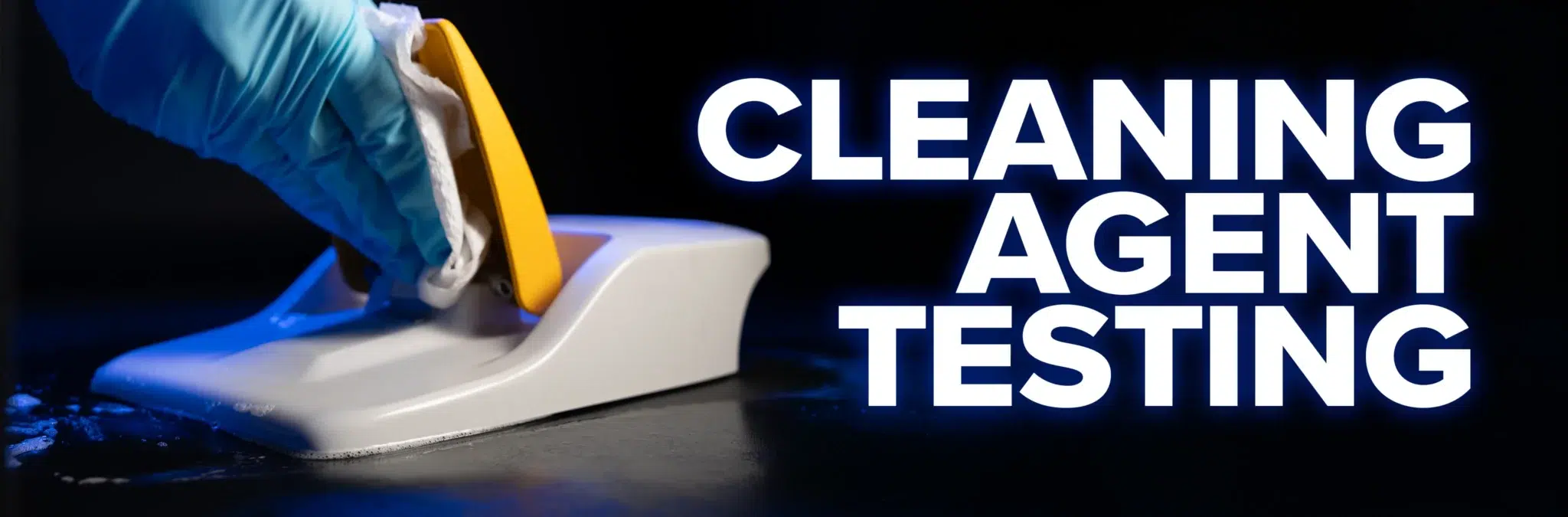
Cleaning Agent Compatibility Testing for Medical Foot Switches: Evaluated Substances and Material Failure Modes
Cleaning protocol, disinfectant exposure, expected cleaning frequency, and applicable ingress protection requirements determine both material selection and verification scope, and are established during requirements definition rather than at the testing stage.
Share the intended function, operating environment, cleaning protocol, expected annual volume, and verification requirements with our engineering and applications teams to review the appropriate evaluation scope for the program.
Cleaning Agent Compatibility Testing for Medical Foot Controls
Medical foot controls are routinely exposed to disinfectants, cleaning solutions, saline, and other chemicals during clinical use. Over the service life of a device, repeated exposure can affect plastics, elastomers, cable jackets, labels, adhesives, metallic interfaces, and sealing components.
Cleaning agent compatibility testing evaluates whether those repeated exposures could contribute to material degradation or changes in product performance.
Because it is not practical to place a new design into years of hospital service during product development, cleaning tests use controlled and accelerated exposure to represent the cumulative real world exposure a device is expected to experience in a hospital or other clinical environment.
The objective is not simply to determine whether a material survives a single contact with a disinfectant. It is to evaluate how repeated cleaning and incidental chemical exposure may affect the product throughout its anticipated service life.

Simulating Real World Hospital Exposure
Cleaning frequency can be significant in procedural and clinical environments. A foot control may be cleaned multiple times per day and may encounter different disinfectants depending on the facility, procedure, and cleaning protocol.
A laboratory evaluation compresses this real world exposure into a controlled test that can be completed during product development and verification.
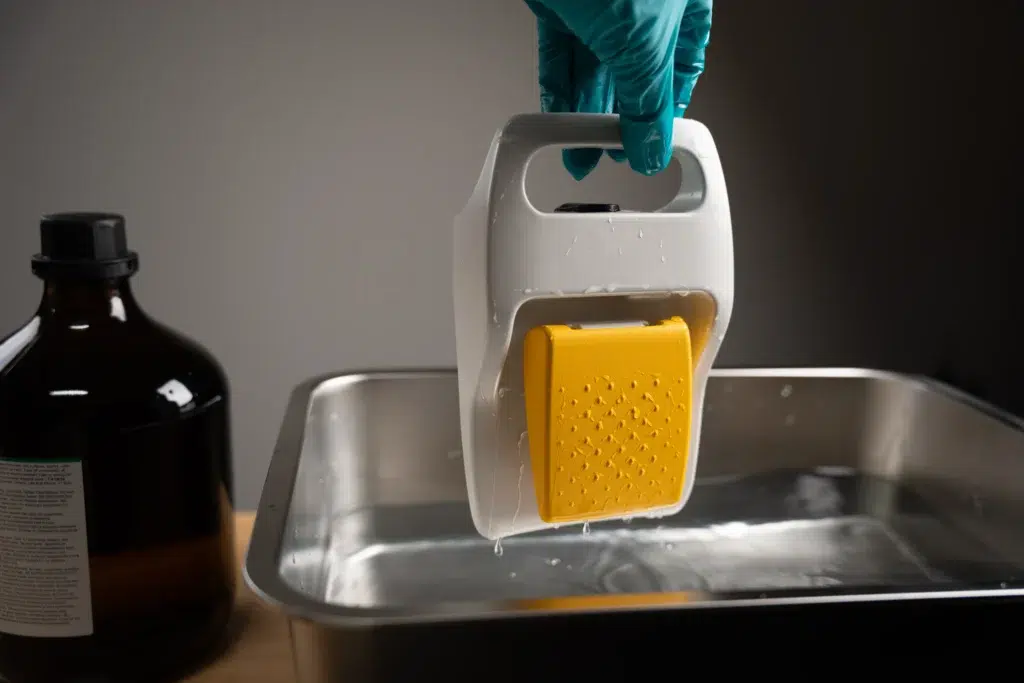
Representative production assemblies may be repeatedly exposed to defined cleaning agents or chemicals using specified concentrations, exposure durations, rinse conditions, and repetition counts. Testing can then evaluate whether this accumulated exposure produces changes in the materials or operation of the device.
Depending on the intended application, substances evaluated may include:
- CaviCide
- CIDEX
- Enzol
- Bleach solutions
- Saline
- Soap solutions
- Isopropyl alcohol
The appropriate agents are determined by the intended cleaning instructions and anticipated clinical environment rather than by applying the same chemical list to every product.
What Is Evaluated?
Chemical exposure does not always produce an immediate or obvious failure. Compatibility testing therefore considers both visible material changes and changes that could affect the operation of the control.
Cracking
Environmental stress cracking can occur in molded thermoplastics, particularly around radii, bosses, fasteners, gate locations, and areas containing residual molding stress.
A housing may initially appear unaffected and later develop cracking as chemical exposure and mechanical loading accumulate.
Surface Degradation
Repeated exposure may cause staining, discoloration, chalking, erosion, loss of gloss, or other changes to the surface.
Not every cosmetic change represents a functional failure, but observed changes should be evaluated against the intended product requirements and cleaning process.
Swelling and Dimensional Change
Elastomers and some polymers can absorb chemicals and change dimensions.
For seals, boots, and gaskets, swelling can affect compression and sealing performance. Dimensional changes in moving components can also affect pedal travel, return position, or activation characteristics.
Loss of Mechanical Properties
Some of the most important effects of chemical exposure may not be visually apparent.
Repeated cleaning exposure can potentially reduce impact resistance, flexibility, tensile properties, or other mechanical characteristics. A component may look unchanged while becoming more susceptible to damage when subsequently dropped, flexed, or mechanically loaded.
This is one reason testing a product only in its new condition may not fully represent its performance later in its service life.
Corrosion and Component Effects
Compatibility evaluations can also consider:
- Corrosion of metallic components
- Cable jacket degradation
- Adhesive bond changes
- Label adhesion
- Printed marking legibility
- Seal condition
- Mechanical operation
- Actuation and return characteristics
Measurements taken before and after exposure can help identify subtle changes that would not necessarily be detected through visual inspection alone.
Cleaning Exposure as Part of Life Cycle Testing
Cleaning does not occur independently from normal use.
During service, a medical foot control may experience repeated cleaning while also being actuated thousands or millions of times, moved between clinical areas, exposed to vibration, and subjected to incidental impact.
For this reason, cleaning compatibility can be incorporated into a broader simulated life cycle evaluation.
A test sequence may include chemical and cleaning agent exposure followed by applicable functional measurements, drop testing, vibration, cycle testing, or other environmental evaluations.
This approach helps answer a more meaningful engineering question:
Does the product continue to perform as intended after experiencing a representative combination of cleaning exposure and mechanical use?
Sequential testing can also identify interactions between failure mechanisms. For example, chemical exposure may weaken a polymer without producing visible damage. A subsequent impact test may reveal a loss of material toughness that would not have been identified through visual inspection following cleaning alone.
Defining the Exposure Protocol
Four primary variables should be considered when developing a cleaning compatibility protocol.
Agent Selection:
Cleaning agents should represent those specified in the intended cleaning instructions or otherwise reasonably expected within the defined clinical environment.
Contact time:
Wiping, saturated contact, soaking, and immersion create different exposure conditions. The selected method should be defined relative to the intended cleaning process and the objective of the evaluation.
Concentration:
Disinfectants and detergents may be supplied ready to use or diluted before application. Concentration can significantly influence the severity of chemical exposure.
Number of exposures:
A single exposure provides limited information about long term compatibility. The number of exposures should represent the anticipated frequency of cleaning over an appropriate portion of the product’s expected service life or provide a justified accelerated equivalent.
Where the final cleaning instructions have not yet been established, the assumptions used to define the test should be documented so the resulting evidence can later be evaluated against the final device labeling.

Cleaning Compatibility Is Not Ingress Protection
Cleaning agent compatibility and ingress protection address different potential failure mechanisms.
Ingress testing evaluates whether liquid enters an enclosure under specified conditions.
Cleaning compatibility testing evaluates whether repeated exposure to a chemical affects the materials and components that make up the product.
A foot control can resist liquid ingress when new while still containing a material that becomes more susceptible to cracking, swelling, embrittlement, or mechanical damage after repeated cleaning exposure.
The evaluations therefore complement one another rather than substitute for one another.
Why Test After Cleaning Exposure?
The condition of a product after prolonged clinical use may be different from its condition when it leaves production.
For that reason, additional testing after simulated cleaning exposure can provide valuable information about how the product may perform later in its service life.
Depending on the product and its requirements, post exposure evaluation may include:
- Visual inspection
- Functional testing
- Actuation position measurement
- Return position measurement
- Drop testing
- Vibration testing
- Cycle or endurance testing
- Seal or ingress evaluation
- Electrical testing
Combining exposure and functional testing provides a more representative evaluation than simply checking whether a test coupon or enclosure still looks acceptable after contact with a cleaning agent.
Why Consider Cleaning Requirements Early?
Cleaning requirements can directly influence decisions involving:
- Housing resin
- Elastomer selection
- Cable jacket material
- Adhesives
- Labels and markings
- Surface finishes
- Sealing methods
- Mechanical geometry
Identifying an incompatibility before tooling and formal verification are complete can allow a material, geometry, or construction method to be revised before the cost and schedule impact becomes significantly greater.
Cleaning and environmental requirements should therefore be considered during requirements definition and material selection rather than treated solely as a final verification activity.
Discuss Cleaning and Environmental Requirements for Your Application
Cleaning protocol, disinfectant exposure, expected cleaning frequency, anticipated service life, and applicable environmental requirements can directly influence material selection and verification strategy for a medical foot control.
Defining these requirements early allows Linemaster’s engineering and applications teams to consider the expected clinical environment during material selection, product design, and verification planning rather than treating cleaning compatibility as an isolated test at the end of development.
Share your intended function, operating environment, cleaning protocol, expected annual volume, and applicable verification requirements with Linemaster to discuss an appropriate evaluation approach for your application.
Frequently Asked Questions
What cleaning agents can medical foot controls be evaluated against?
Depending on the intended clinical environment, evaluations can include substances such as CaviCide, CIDEX, Enzol, diluted bleach solutions, saline, soap solutions, and isopropyl alcohol.
The appropriate substances depend on the cleaning process intended for the finished medical device.
What does cleaning compatibility testing evaluate?
Testing can evaluate cracking, degradation, swelling, corrosion, loss of mechanical properties, cable jacket changes, adhesive or label degradation, dimensional change, and changes in functional performance.
Does cleaning testing reproduce years of hospital use?
Not literally. Controlled and accelerated exposure is used to represent the cumulative cleaning and incidental chemical exposure expected during real world clinical use within a practical development and verification timeframe.
The relationship between the accelerated test and the intended use environment should be defined as part of the test protocol.
Why are complete assemblies tested instead of only material samples?
Material samples can provide useful screening information, but complete assemblies include molded stresses, fasteners, interfaces, seals, adhesives, cables, and moving components that may respond differently to chemical exposure.
Assembly level testing can therefore identify interactions that may not be apparent from material data alone.
Is cleaning compatibility the same as water resistance?
No. Water resistance or ingress testing evaluates liquid penetration. Cleaning compatibility evaluates the effect of chemical exposure on the materials and components of the product.
Why evaluate the product after chemical exposure?
Some degradation mechanisms become significant only when the exposed material is subsequently subjected to mechanical loading. Functional, drop, vibration, cycle, or other applicable evaluations performed after chemical exposure can provide a more representative assessment of the product after simulated service exposure.
Meet The Author

Arijan Kandic
Digital Marketing Specialist
Arijan is the Digital Marketing Specialist at Linemaster Switch Corporation and holds a bachelor’s degree in business management from Quinnipiac University. He manages the company’s SEO strategy, Google Ads campaigns, and digital marketing initiatives, and develops educational content for the Linemaster Learning Center to help engineers, OEMs, and medical device manufacturers better understand foot switch technology. Arijan works closely with Linemaster’s engineering and applications teams to translate complex technical concepts into clear, accurate articles on foot switch design, customization, and compliance considerations.
In Collaboration with

Sean Lewis
Director of Engineering
Sean has more than fifteen years of experience in product development, engineering governance, and cross functional technical operations. His background in metal fabrication, including machining, forming, welding, and inspection, provides a strong manufacturing foundation that supports his approach to design and process optimization. Sean holds a bachelor’s degree in mechanical engineering, an MBA with a manufacturing concentration, and an MSOL. He is a Certified SolidWorks Expert with advanced capability in CAD, rendering, simulation, and rapid prototyping. Sean also specializes in DFMEA and PFMEA risk management practices and is the holder of several foot switch design and utility patents.
Uploaded 08/13/2026
Custom Foot Switches
Linemaster’s custom footswitches are designed to meet specific user requirements, offering a range of features such as various pedal configurations, wired and wireless options, and customizable LED indicators. These custom footswitches provide reliable, durable solutions tailored to enhance functionality in diverse applications.

