
When Are Guards Required for Medical Foot Switches Under IEC 60601
Medical foot switches control some of the most critical functions in modern healthcare equipment. Cutting, coagulation, laser emission, imaging, powered motion, and more all run through the press of a pedal. In most of these cases the operator can’t keep their eyes on the foot switch while they work, which means the pedal is operating in an environment full of cables, moving staff, and the kind of unpredictability you can’t engineer out of a clinical setting.
That’s where guarding becomes a design consideration.
Unintended activation isn’t just a design quirk to manage. It’s the central safety concern that drives whether a guard belongs on a foot switch in the first place.
When a Guard Is Actually Required
IEC 60601 doesn’t have a clause that says, “use a guard.” What it does require is that manufacturers eliminate unacceptable risk. Under IEC 60601-1 Clause 4.2, risk management must be applied throughout the design process to ensure hazards are reduced to acceptable levels. In practice, that often makes a guard the most direct path to compliance.
A guard typically becomes necessary when the foot switch controls something where an accidental press could cause harm. That includes energy delivery systems like electrosurgery, lasers, and RF ablation, motion control on tools like orthopedic drills or surgical robots, and radiation triggers on imaging systems such as X-ray and fluoroscopy. It also applies in environments where accidental contact is more likely, such as operating rooms, crowded procedural areas, and any setup where the user can’t maintain visual contact with the pedal.
If unintended activation can hurt the patient or the operator, a guard or an equivalent mitigation needs to be part of the design.
In practice, many Class II and Class III surgical systems incorporate guarded foot switches as a standard risk control due to the severity of potential customers.
The IEC Standards That Drive Guarding
Guarding requirements aren’t pulled from a single clause. They come from a combination of safety, usability, and particular standards working together.
IEC 60601-1:
Addresses general safety. Key clauses cover risk management (Clause 4.2), mechanical hazards and unintended movement (Clause 9.4 and 9.8), single fault conditions, construction (Clause 15) that prevents unintended operation, and controls designed to minimize use error.
IEC 60601-1-6:
Focuses on usability engineering, and it’s one of the bigger drivers behind guarding. It pushes manufacturers to reduce use error, factor in human behavior, and validate the design under realistic conditions. That’s where guarding earns its place as a way to prevent accidental activation and incorrect pedal selection.
The IEC 60601 particular standards are when guarding becomes functionally necessary to achieve acceptable risk levels for higher risk applications. Standards like IEC 60601-2-2 for electrosurgical equipment, IEC 60601-2-22 for medical lasers, IEC 60601-2-43 for X-ray equipment, and IEC 60601-2-18 for endoscopic systems all set risk thresholds that often result in guarding being required as a risk control measure.

What Makes a Guard IEC Compliant
IEC standards don’t define a specific guard shape, dimension, or material. Compliance comes down to whether the guard actually works as a risk control.
A compliant guard needs to prevent inadvertent actuation, require deliberate user action, reduce the probability of use error, remain effective under single fault conditions as defined in IEC 60601-1, and prove its effectiveness through testing and usability studies.
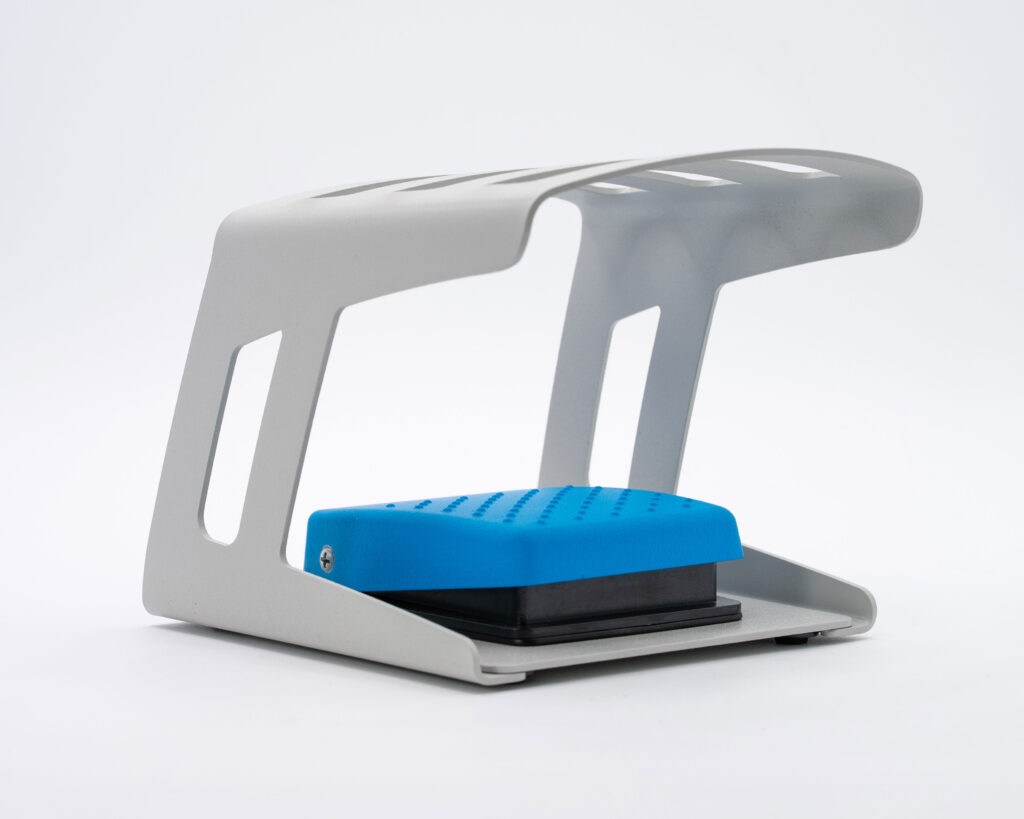
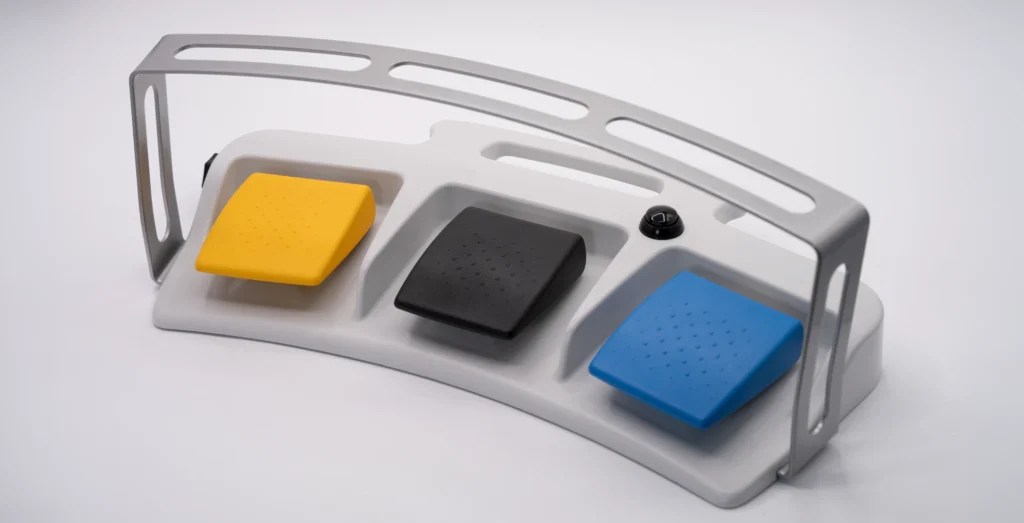
The design itself can take a few forms. Physical guarding includes pedal shrouds, raised side walls, and recessed pedal geometry. Mechanical design uses a defined actuation force, controlled pedal travel, and tactile feedback to confirm intent. Additional risk control measures may supplement or replace physical guarding, such as enable plus activate logic, two step activation, or dead man controls. User interface design covers things like pedal spacing, tactile differentiation, and shape variation between pedals so the operator doesn’t grab the wrong one.
How Linemaster Builds Guards for Real World Use
On the construction side, our guards are built from materials selected for the environments they’re going to live in. That includes heavy gauge rolled steel, cast aluminum, plastic, and brushed stainless steel, depending on the application and the level of impact protection needed. Anti-skid base pads are applied to the bottom of the guards to maintain traction between the guard and the floor or work surface, which directly supports the risk control role the guard is playing.
Guards can be specified at the time of order or added to stock foot switch models after the fact. Off the shelf guards ship with the fasteners needed to attach them, so customers can purchase them separately and install them on a switch they already own. That flexibility makes it easier for OEMs and end users to align the guarding decision with the risk profile of their specific application.
Where Risk Management and DFMEA Come In
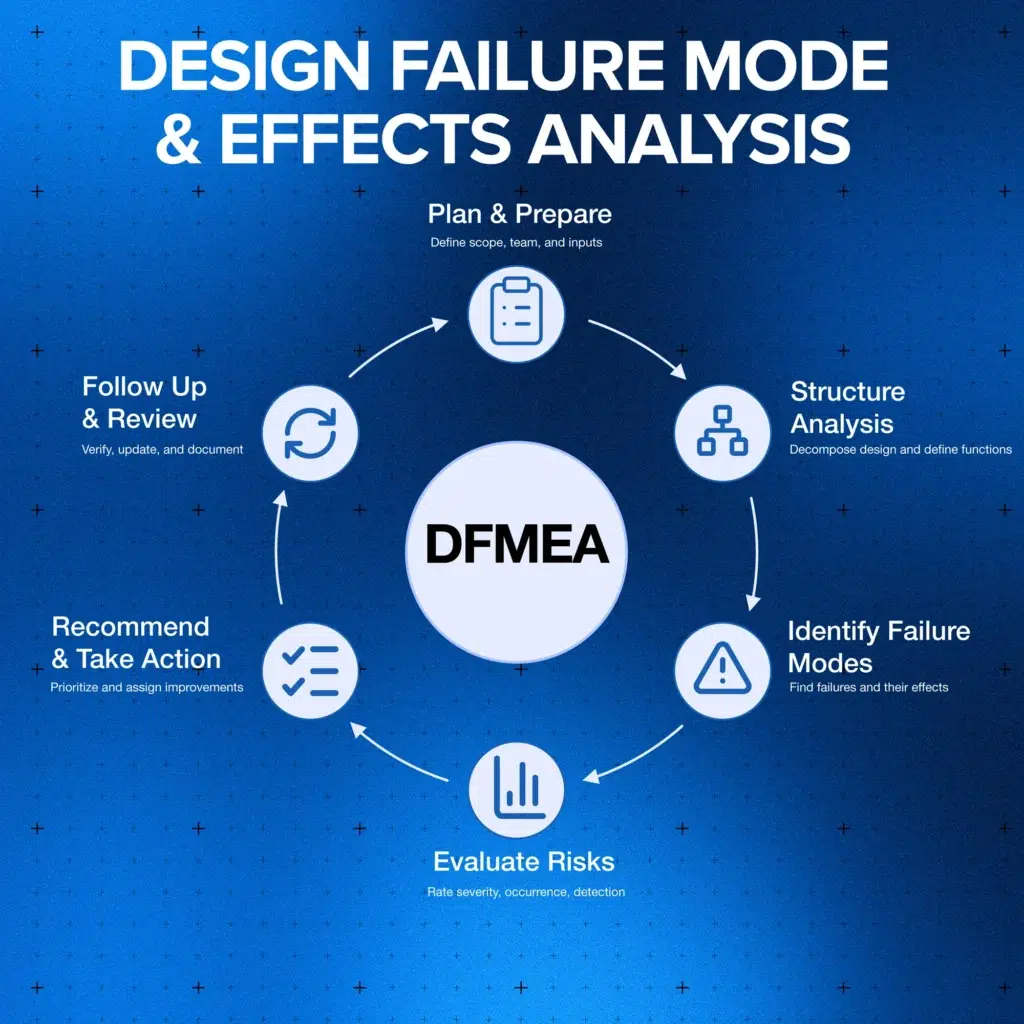
Guarding decisions are documented within the ISO 14971 risk management file, often supported by a Design Failure Mode and Effects Analysis, more commonly called a DFMEA.
The failure mode is unintended foot switch actuation. The effects depend on the application but typically include unintended cutting, unintended laser emission, unintended radiation exposure, or unintended tool motion. In most of these scenarios the severity rating is high.
The causes are usually environmental. A dropped instrument, an incidental foot contact, cable or tubing interference, a crowded operating room, or a moment of distraction.
This is where guarding earns its role. It doesn’t reduce severity. It reduces the likelihood that the activation happens in the first place. If the DFMEA shows that unintended actuation creates unacceptable risk, then a physical guard or equivalent validated control needs to be part of the design.
Failure to implement appropriate risk controls in these scenarios is a common source of nonconformities during regulatory review.
How Compliance Gets Evaluated
Test labs like UL and TÜV evaluate guarding as part of the broader device review. They look at whether the risks were properly identified, whether the guard actually reduces those risks, and whether the design holds up under realistic use.
Verification methods can include actuation force testing, obstruction and interference testing, dropped object assessment, durability cycling, and simulated clinical use validation.
When a Guard May Not Be Required
In lower risk applications, a guard may not be necessary if the risk of unintended activation is already controlled to an acceptable level. Examples may include signaling functions, low energy controls, or systems with secondary confirmation steps. Controlled environments where accidental contact is unlikely may also reduce the need for physical guarding.
However, this determination must be justified through risk management and validated through usability and verification testing.
Common Misconceptions About Foot Switch Guarding
A few ideas come up often in these conversations.
The first is that guards are optional. They’re not, at least not when the risk profile says otherwise. The second is that IEC sets a specific guard dimension. It doesn’t. IEC sets performance expectations, not geometry. The third is that guarding only matters for high end surgical systems. It doesn’t. Guards are just as common on simpler devices where the risk of accidental activation is real.
Conclusion
Foot switch guarding sits at the intersection of safety, usability, and risk management. IEC 60601 doesn’t spell it out as a standalone requirement, but the framework around it makes guarding a practical necessity any time unintended activation can lead to harm. ISO 14971 documents the decision, the DFMEA formalizes the need, and testing proves it works.
If unintended foot switch activation can create harm in your application, a guard or an equivalent protective measure should be part of the design from the start.
If you are designing a medical foot switch and evaluating guarding requirements, Linemaster Switch Corporation can support risk informed design, usability validation, and IEC 60601 compliance.
Want to go deeper on medical foot switch safety and compliance? Explore more on usability engineering, accidental activation prevention, and design considerations in our Learning Center.
Meet The Author

Arijan Kandic
Digital Marketing Specialist
Arijan is the Digital Marketing Specialist at Linemaster Switch Corporation and holds a bachelor’s degree in business management from Quinnipiac University. He manages the company’s SEO strategy, Google Ads campaigns, and digital marketing initiatives, and develops educational content for the Linemaster Learning Center to help engineers, OEMs, and medical device manufacturers better understand foot switch technology. Arijan works closely with Linemaster’s engineering and applications teams to translate complex technical concepts into clear, accurate articles on foot switch design, customization, and compliance considerations.
In Collaboration with

Sean Lewis
Director of Engineering
Sean has more than fifteen years of experience in product development, engineering governance, and cross functional technical operations. His background in metal fabrication, including machining, forming, welding, and inspection, provides a strong manufacturing foundation that supports his approach to design and process optimization. Sean holds a bachelor’s degree in mechanical engineering, an MBA with a manufacturing concentration, and an MSOL. He is a Certified SolidWorks Expert with advanced capability in CAD, rendering, simulation, and rapid prototyping. Sean also specializes in DFMEA and PFMEA risk management practices and is the holder of several foot switch design and utility patents.
Uploaded 04/30/2026
Custom Foot Switches
Linemaster’s custom footswitches are designed to meet specific user requirements, offering a range of features such as various pedal configurations, wired and wireless options, and customizable LED indicators. These custom footswitches provide reliable, durable solutions tailored to enhance functionality in diverse applications.

