
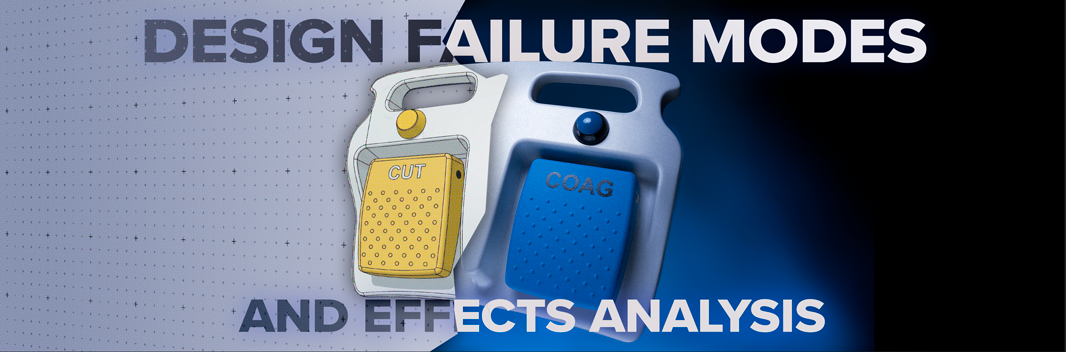
Risk Analysis and Failure Mode Evaluation in Medical Foot Controls
In medical environments, reliability is not just expected, it is built into the design from the start. Behind every safety feature in a medical foot control is a structured approach to identifying and reducing risk. One of the most commonly used methods for this is Design Failure Modes and Effects Analysis, or DFMEA.
DFMEA is a systematic way to evaluate how a device could fail and what the impact of those failures might be. Rather than reacting to issues after they occur, this process helps teams anticipate potential problems early in development and design around them.
Understanding DFMEA in Medical Foot Controls
At its core, DFMEA focuses on three key factors.
Severity looks at how serious the outcome of a failure would be. In the case of medical foot controls, this is often tied to the larger system the device is connected to.
Occurrence evaluates how likely it is that a failure could happen in the first place. This helps guide design decisions that reduce the chances of something going wrong.
Detection considers how easily a failure can be identified before it leads to a larger issue. Systems that are able to detect faults early can prevent unintended behavior and improve overall reliability.
How Risk Priority Numbers Guide Design Decisions
These three factors are combined to calculate what is known as a risk priority number. This value helps guide both design decisions and testing requirements, ensuring that higher-risk areas are addressed with the appropriate level of attention.
Addressing Risk in Real-World Medical Applications
One important risk considered during development is the potential for delays during surgery or therapy. If a device needs to be reset or serviced during a procedure, it can interrupt clinical workflows and impact overall efficiency. To help minimize this risk, design strategies often include redundancy, durability testing, and fault detection mechanisms. These approaches support more consistent operation while also making it easier to identify and respond to issues if they occur.
Risk Analysis as an Ongoing Process
Risk analysis is not a one-time step. It is part of an ongoing process that helps ensure medical foot controls continue to perform as expected within the systems they support. By evaluating severity, occurrence, and detection early and throughout development, these devices are designed with a clear focus on reliability and safety.
See the Calculator Below
How Linemaster reduces design risk: the DFMEA process
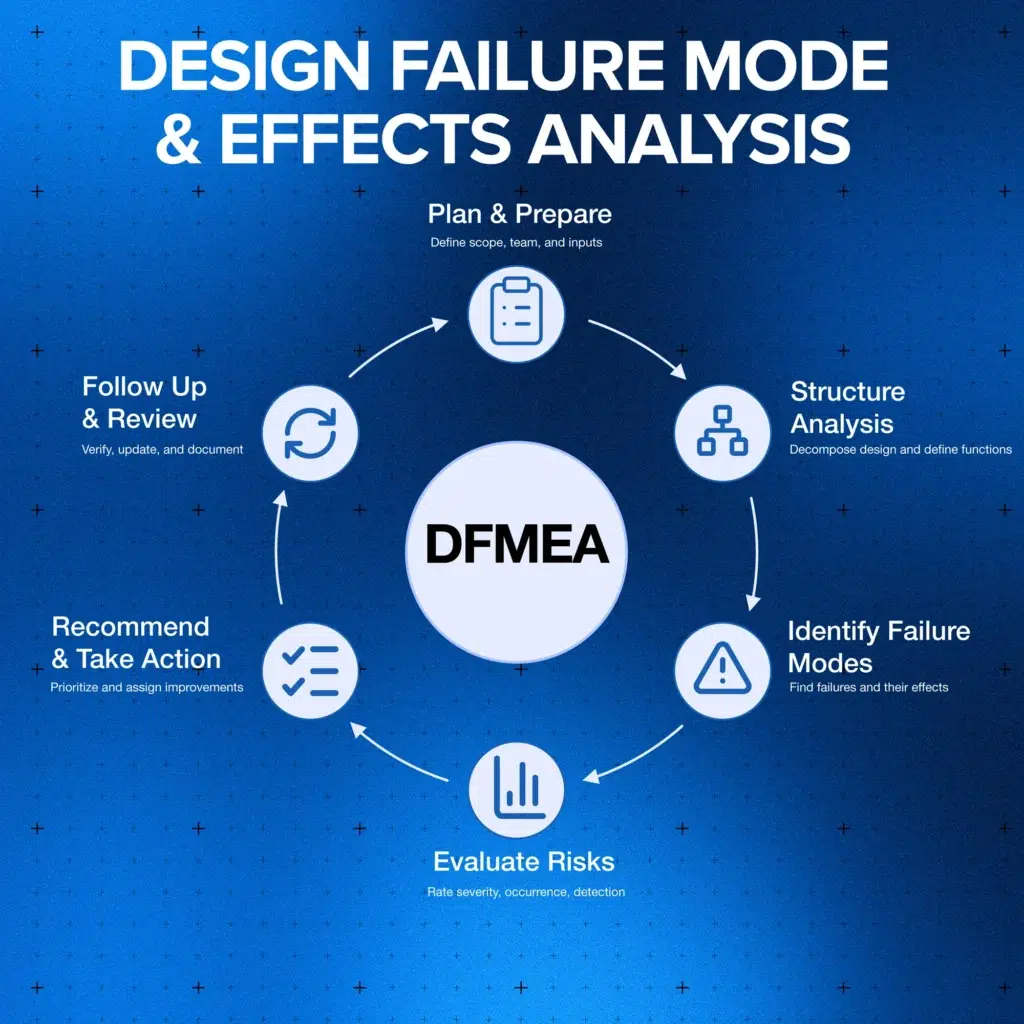
Design Failure Modes and Effects Analysis is how engineering teams anticipate problems before they reach production. It is a structured, six-step method for surfacing risk early, prioritizing what matters most, and designing accordingly. Click through each step to see how it works.
Plan and prepare
Every DFMEA begins with the boundaries of the analysis. Before any failure modes are evaluated, the team defines what is being analyzed, who is involved, and what reference material the work will draw from. Skipping this step is the most common reason a DFMEA produces inconsistent results later.
Key activities
- Define the scope and objectives of the analysis
- Assemble a cross-functional DFMEA team
- Gather drawings, requirements, standards, and lessons learned from prior programs
- Document assumptions and boundaries
Why it matters
- Aligns the team on what the analysis covers and what it does not
- Surfaces existing knowledge so failures are not rediscovered
- Prevents scope drift later in the process
Structure analysis
A foot switch is not analyzed as a single object. The team breaks the design into its system, subsystems, components, and features, then defines what each element is supposed to do. This decomposition gives the rest of the analysis something concrete to work against.
Key activities
- Decompose the design into system, subsystems, components, and features
- Define the function of each element
- Map relationships between elements
Why it matters
- You cannot evaluate how something fails without knowing what it is supposed to do
- Forces explicit thinking about how components interact
- Creates a shared reference for the rest of the analysis
Identify failure modes
For every element defined in the previous step, the team asks how it could fail and what would happen if it did. The goal is not to predict every possible defect, but to capture the failure modes that would matter to the next-higher assembly or to the end user.
Key activities
- For each design element, identify potential failure modes
- Describe the effects on the next higher level element
- Trace consequences through to the end user or clinical environment
Why it matters
- Captures the chain of consequences from a low-level fault to a system-level effect
- Surfaces safety-critical issues that would otherwise be invisible at the component level
- Builds the foundation for risk evaluation in the next step
Evaluate risks
Each failure mode is rated on three dimensions: how serious it would be (Severity), how likely it is to happen (Occurrence), and how easily it would be caught before reaching the customer (Detection). These ratings are multiplied to produce a Risk Priority Number that guides where engineering effort should focus.
Recommend and take action
RPN values are not the deliverable. The point is what the team does about them. High-risk items get prioritized for design changes, additional testing, or new detection methods. Each action is assigned to an owner with a target completion date so the work does not sit on a list.
Key activities
- Identify and prioritize high-risk items based on RPN
- Recommend design actions to reduce severity, occurrence, or improve detection
- Assign owners and target completion dates
Why it matters
- Translates analysis into concrete design changes
- Forces accountability for risk reduction
- Documents the reasoning behind design decisions for future review
Follow up and review
Risk analysis is not a one-time deliverable. After actions are implemented, the team re-evaluates the affected failure modes, updates the DFMEA, and captures lessons learned. The DFMEA becomes a living document that informs the next program and continues to evolve as the design matures.
Key activities
- Implement recommended actions
- Re-evaluate risks once changes are in place
- Update the DFMEA to reflect the current state of the design
- Communicate results and lessons learned across the organization
Why it matters
- Confirms that actions actually reduced risk rather than just being checked off
- Builds institutional knowledge that carries into future designs
- Closes the loop and starts the cycle over for the next program
Final Thoughts
Understanding how risk is evaluated provides important context for how safety features are developed and implemented. DFMEA plays a key role in guiding these decisions, helping teams prioritize what matters most and design accordingly. To see how these risk-based decisions translate into real world design features, explore our full medical foot control safety features overview and learn how these systems are built to support safe and consistent operation.
Meet The Author

Arijan Kandic
Digital Marketing Specialist
Arijan is the Digital Marketing Specialist at Linemaster Switch Corporation and holds a bachelor’s degree in business management from Quinnipiac University. He manages the company’s SEO strategy, Google Ads campaigns, and digital marketing initiatives, and develops educational content for the Linemaster Learning Center to help engineers, OEMs, and medical device manufacturers better understand foot switch technology. Arijan works closely with Linemaster’s engineering and applications teams to translate complex technical concepts into clear, accurate articles on foot switch design, customization, and compliance considerations.
In Collaboration with

Sean Lewis
Director of Engineering
Sean has more than fifteen years of experience in product development, engineering governance, and cross functional technical operations. His background in metal fabrication, including machining, forming, welding, and inspection, provides a strong manufacturing foundation that supports his approach to design and process optimization. Sean holds a bachelor’s degree in mechanical engineering, an MBA with a manufacturing concentration, and an MSOL. He is a Certified SolidWorks Expert with advanced capability in CAD, rendering, simulation, and rapid prototyping. Sean also specializes in DFMEA and PFMEA risk management practices and is the holder of several foot switch design and utility patents.
Uploaded 04/29/2026
Custom Foot Switches
Linemaster's custom footswitches are designed to meet specific user requirements, offering a range of features such as various pedal configurations, wired and wireless options, and customizable LED indicators. These custom footswitches provide reliable, durable solutions tailored to enhance functionality in diverse applications.

