
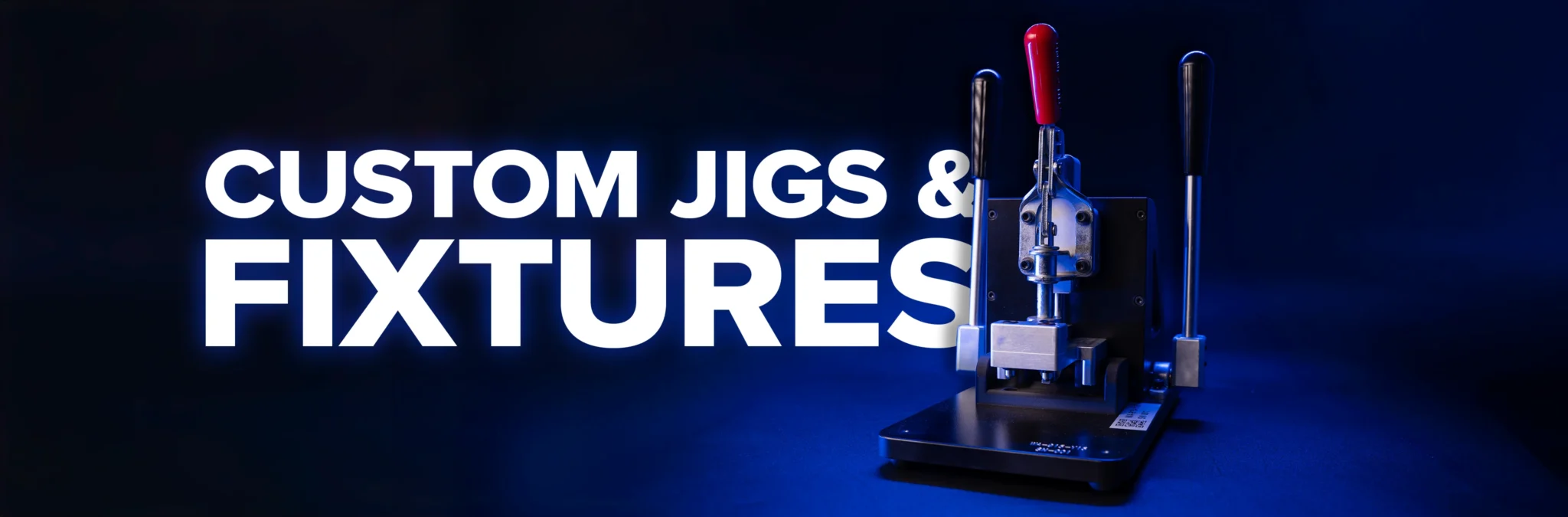
Custom Manufacturing Jigs and Fixtures: Supporting Precision Production at Linemaster
In precision manufacturing, standard tools only get you so far. When products need to be assembled the same way every time, with tight tolerances and repeatable results across thousands of units, off the shelf equipment usually isn’t enough. That’s where custom manufacturing jigs and fixtures come in.
Across our production floor, custom manufacturing fixtures support nearly every stage of building our industrial and medical foot switches. From torque-controlled assembly and epoxy potting to precision machining and component alignment, custom production tooling is a big part of how we maintain the consistency our customers rely on.
What Manufacturing Jigs and Fixtures Actually Do
At a basic level, jigs and fixtures hold, align, support, or position components during production. In a precision environment, that role becomes critical. They reduce assembly variation, make operator workflows more consistent, and help support repeatable results from one production run to the next.
A well-designed manufacturing fixture can improve assembly accuracy, product consistency, operator ergonomics, process repeatability, and overall production efficiency. Many of the fixtures used on our floor are designed internally to fit specific assembly processes and product configurations.
Assembly Positioning Fixtures
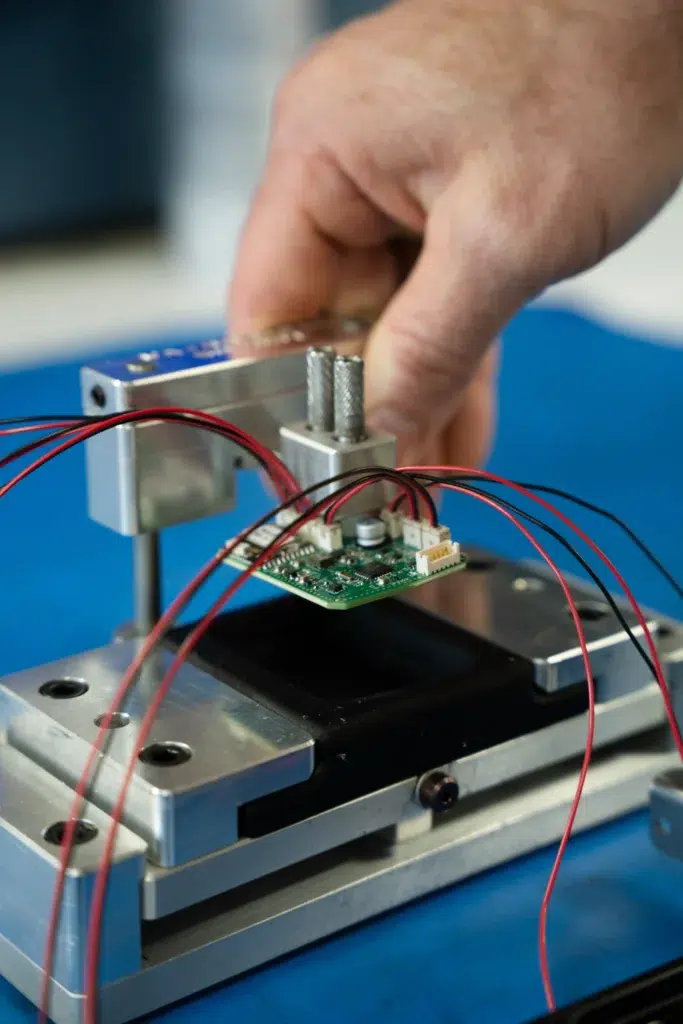
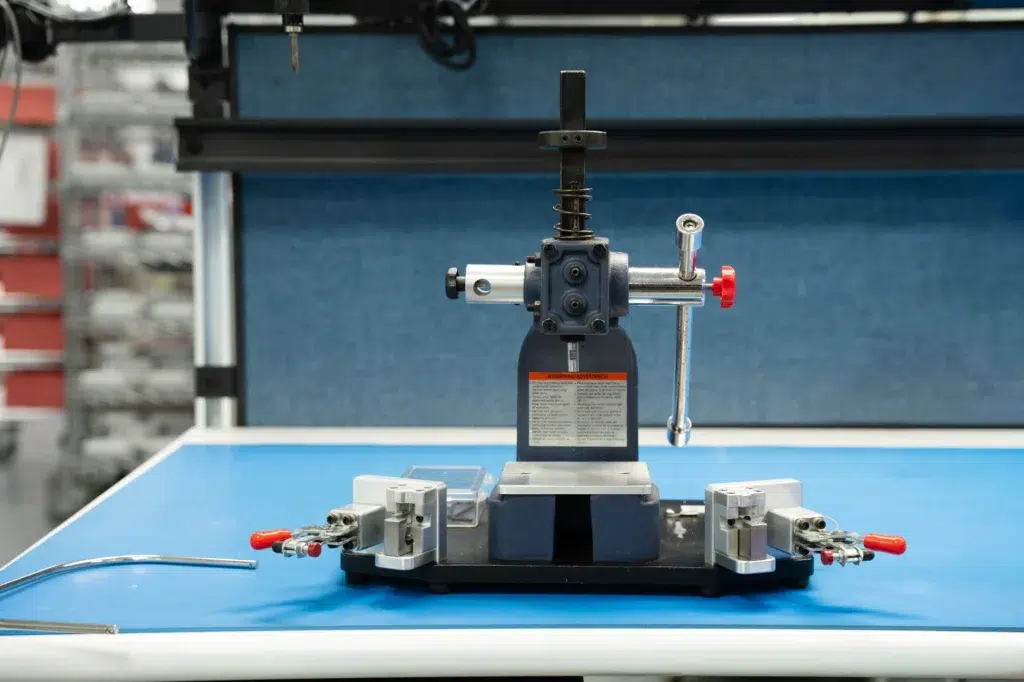
Some of the most commonly used fixtures in our production are simple assembly positioning fixtures. These hold switches, housings, and subassemblies in the right orientation while operators work on them. They help align components more accurately and free up the operator’s hands, which leads to better placement and tighter process control.
It’s a small detail that makes a real difference in product consistency from one lot to the next.
Torque Fixtures for Connectors and Switch Assemblies
Some assembly steps require switches or electrical connectors to be tightened to specific torque values. To support these operations, we use custom torque fixtures that securely hold the assembly while it’s being fastened.
The fixture keeps everything aligned, prevents the part from shifting during tightening, and helps support more consistent torque results. It also reduces the chance of damaging components during assembly, which matters a lot for products where mechanical stability and electrical reliability go hand in hand.
Potting Fixtures for Epoxy Filling
A lot of our foot switch assemblies go through a potting step, where epoxy is used to protect internal components from moisture, vibration, contaminants, and other environmental exposure.
Custom potting fixtures hold foot switches and subassemblies in the right position during epoxy filling, which helps keep epoxy placement and material distribution repeatable across production runs. For medical foot switch manufacturing in particular, this kind of controlled potting process supports the environmental sealing and long-term durability you want in a healthcare environment.
Label Placement and Alignment Fixtures
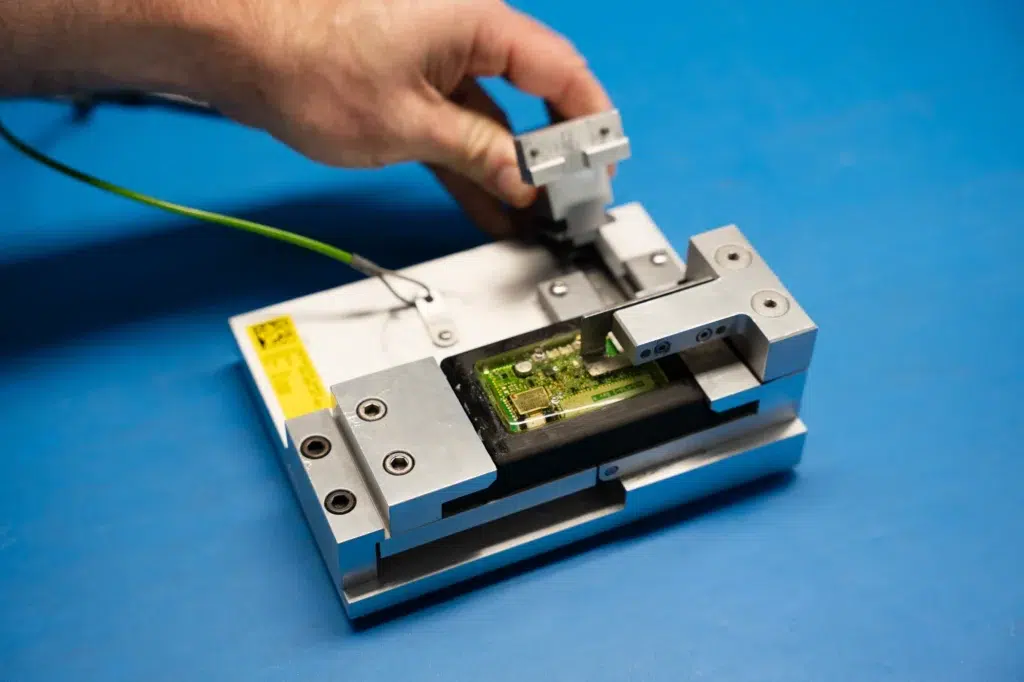
Consistent label placement might sound minor, but it matters for product identification, traceability, branding, and regulatory compliance. Custom label alignment fixtures help operators apply labels accurately and uniformly, which keeps the finished product looking clean and supports compliance requirements at the same time.
Machining Fixtures for Precision Manufacturing
On the machining side, custom machining fixtures securely hold components during drilling, milling, tapping, and other operations. They help maintain dimensional consistency, improve repeatability, reduce setup variability, and support tighter tolerances. Whether we’re machining a prototype or running production parts, precision machining fixtures are a big part of how we maintain our manufacturing standards.
Spring Loading and Snap Fit Assembly Fixtures
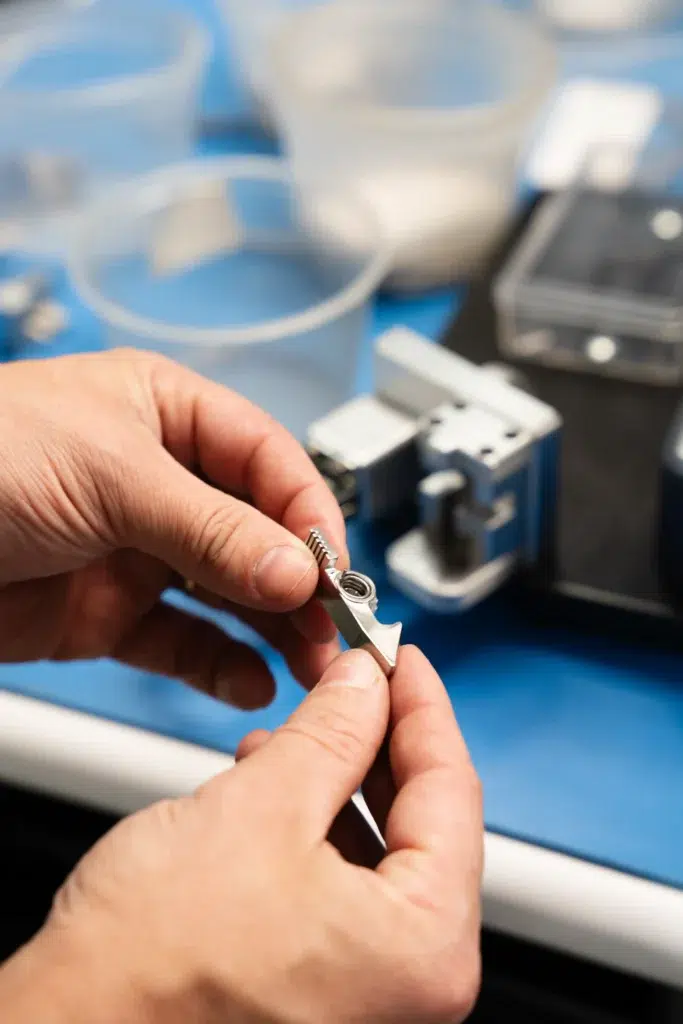
Some assemblies need springs installed in places where doing it by hand is tough to do consistently. Custom spring loading fixtures make this process more ergonomic for operators while making sure the spring lands where it should.
We also use fixtures to assist with snap fit assembly, where controlling alignment and insertion forces is important to avoid damaging the parts. And in some situations, we use dedicated fixtures for the opposite task: taking snap fit components apart cleanly during inspection, validation, repair, or rework.
Staking Fixtures for Permanent Mechanical Connections
Some switch assemblies use staking to create permanent mechanical connections. Staking deforms metal components in specific areas to lock parts together, and custom staking fixture is what makes that controlled and repeatable.
A good staking fixture keeps the part aligned, controls exactly where the staking happens, protects surrounding components, and supports consistent results across the assembly process. Getting the fixture design right is one of the more important factors in long term mechanical reliability.
Engineering Driven Manufacturing Support
Our engineering, manufacturing, and quality teams work together to design and validate the custom production tooling used on the floor. The collaboration is what keeps our tooling aligned with product requirements and quality standards as new products come through and existing ones evolve.
It’s also what supports our continuous improvement work, since the people closest to the process are usually the ones who see opportunities to refine it.
Fixture Qualification and Validation
Before any custom fixture goes into production use, it goes through a formal qualification process. That includes Installation Qualification (IQ) and Operational Qualification (OQ),
which together help verify that the fixture performs the way it’s supposed to and supports a repeatable process.
For regulated manufacturing environments, where process control and documentation are essential, validated tooling becomes a key part of maintaining compliance and consistency.
Preventive Maintenance for Manufacturing Tooling
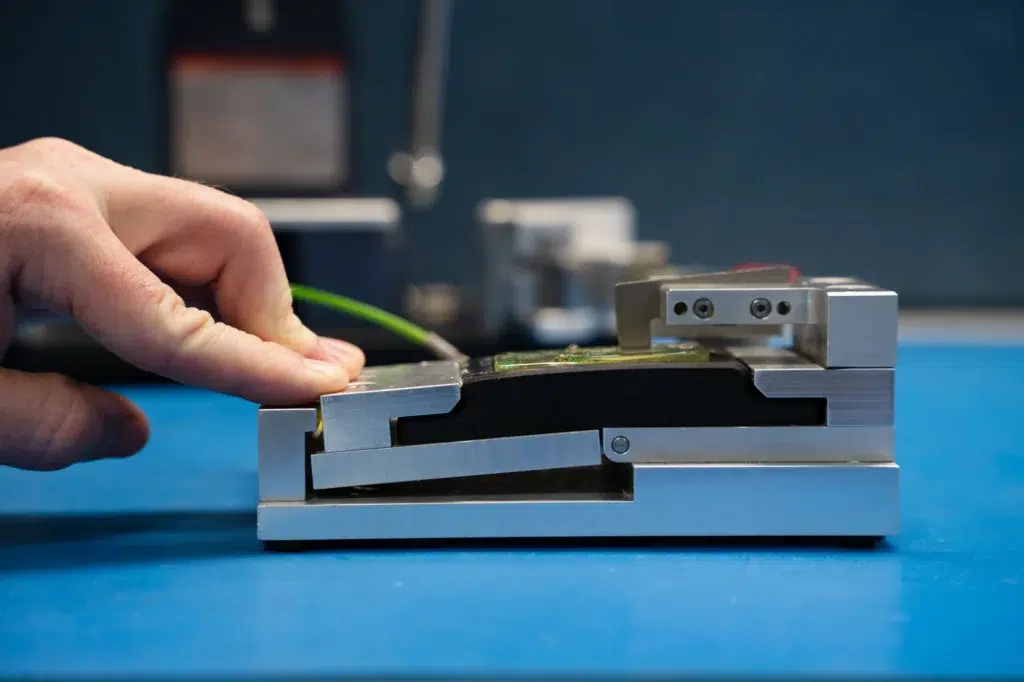
Manufacturing fixtures aren’t a “set it and forget it” part of the process. We follow defined Preventive Maintenance (PM) schedules for our production tooling, which include routine inspections, functional evaluations, wear assessments, fixture adjustments, and repair or replacement when something isn’t holding up.
PM is how we keep production tooling working the way it should over the long haul, which keeps production performance stable as fixtures age.
Supporting Precision Manufacturing Through Custom Tooling
Custom manufacturing jigs and fixtures are a critical part of how modern production actually works. From precision assembly tooling and machining fixtures to potting and staking operations, they’re often what separates a process that mostly works from one that delivers consistent results across thousands of units.
Combining engineering expertise, validated processes, and internally developed tooling is what allows us to support customers with the kind of dependable manufacturing they need for industrial and medical applications.
Want to learn more about our custom manufacturing capabilities, precision assembly processes, or custom foot switch solutions? Get in touch with us anytime.
Meet The Author

Arijan Kandic
Digital Marketing Specialist
Arijan is the Digital Marketing Specialist at Linemaster Switch Corporation and holds a bachelor’s degree in business management from Quinnipiac University. He manages the company’s SEO strategy, Google Ads campaigns, and digital marketing initiatives, and develops educational content for the Linemaster Learning Center to help engineers, OEMs, and medical device manufacturers better understand foot switch technology. Arijan works closely with Linemaster’s engineering and applications teams to translate complex technical concepts into clear, accurate articles on foot switch design, customization, and compliance considerations.
In Collaboration with

Sean Lewis
Director of Engineering
Sean has more than fifteen years of experience in product development, engineering governance, and cross functional technical operations. His background in metal fabrication, including machining, forming, welding, and inspection, provides a strong manufacturing foundation that supports his approach to design and process optimization. Sean holds a bachelor’s degree in mechanical engineering, an MBA with a manufacturing concentration, and an MSOL. He is a Certified SolidWorks Expert with advanced capability in CAD, rendering, simulation, and rapid prototyping. Sean also specializes in DFMEA and PFMEA risk management practices and is the holder of several foot switch design and utility patents.
Uploaded 09/01/2026
Custom Foot Switches
Linemaster’s custom footswitches are designed to meet specific user requirements, offering a range of features such as various pedal configurations, wired and wireless options, and customizable LED indicators. These custom footswitches provide reliable, durable solutions tailored to enhance functionality in diverse applications.

