
Bluetooth Low Energy vs RF: A Look at Wireless Foot Switch Communication
When engineers evaluate a wireless foot switch for a new system, the conversation often starts with cables and convenience. What gets less attention, at least early on, is the wireless protocol itself. The protocol determines how the signal travels between the foot pedal and the equipment, and it shapes everything from range and latency to security and battery life.
Two protocols come up most often: traditional RF (radio frequency) wireless and Bluetooth Low Energy, usually called BLE. Both move a signal through the air without a cord, but the way they do it, and what each is best suited for, isn’t the same. Here’s how RF works in a foot switch today, what BLE adds to the picture, and how Linemaster is approaching both.
How RF Wireless Works in a Foot Switch
An RF wireless foot switch transmits the control signal between the pedal and the equipment without a physical cord. Inside the pedal, electronics convert the press into a wireless transmission. A receiver, either built into the system or connected through an external interface, captures that signal and reproduces the same electrical output a wired switch would deliver.
Linemaster’s RF wireless platform operates in the 2.4 GHz ISM band and follows the IEEE 802.15.4 standard. The communication scheme is proprietary and intentionally one directional, which means it doesn’t rely on a bi-directional link or acknowledgement message back to the transmitter. That design choice reduces air traffic and lowers the chance of interference, which matters in environments where multiple wireless devices may be operating in nearby rooms.
The performance numbers fill in the rest. A typical Linemaster RF wireless foot switch operates with latency under 47 milliseconds and runs on standard AA alkaline batteries. Channel hopping and randomly dithered redundant transmissions help the system stay reliable when the wireless environment is crowded.
Security is built into the same platform. Linemaster’s RF wireless foot switch use 144-bit encryption, which goes beyond the 128-bit industry standard, along with super encipherment, where more than one encryption method is layered onto the same signal. Each transmission is broken into perishable packets that expire after they’re received, so
they can’t be replayed later. These protections are part of the system design rather than a software add on.
What Bluetooth Low Energy Brings to the Picture
Bluetooth Low Energy is a wireless protocol designed around two ideas: low power consumption and broader interoperability with modern device ecosystems. Its part of the next generation of wireless foot switch development at Linemaster, alongside battery power optimization strategies, secure device communication, control architecture.
For OEMs, BLE opens up integration patterns that traditional proprietary RF wasn’t built around. It’s a widely adopted protocol, and that adoption means it can interface more naturally with the kind of connected systems that have become common in medical and industrial equipment. The expansion of BLE within Linemaster’s wireless roadmap reflects how wireless foot switches are increasingly expected to fit into larger device ecosystems rather than operating standalone links.
Where the Two Differ in Practice
The clearest way to think about RF and BLE is that they’re solving different problems.
Traditional RF, as Linemaster implements it, is built for a controlled, dedicated link between a foot pedal and a single piece of equipment. The proprietary scheme, the channel hopping, the layered encryption, and the perishable packets are all there to make that one link as reliable and secure as possible in environments with a lot of wireless activity. It’s a closed loop by design. It is also easier for customization to fit unique applications because it does have to adhere to open interoperable standards. It can be highly optimized to lower power consumption without having to do all things required by the standard protocols.
BLE is built for a more open, interoperable world. It’s the protocol that connects phones, wearables, sensors, and an expanding range of medical devices. When a foot switch needs to be part of a broader connected ecosystem, BLE has architecture strengths that a closed proprietary link wasn’t designed around, but at the expense of less flexibility in changes and customizations because it is bounded by the standard protocol. It has slightly higher power consumption than the proprietary RF as the result.
Neither approach is universally better. The right answer depends on what the equipment needs, what environment it operates in, and how the foot switch fits into the larger system.
Where Each Fits in Linemaster’s Wireless Lineup
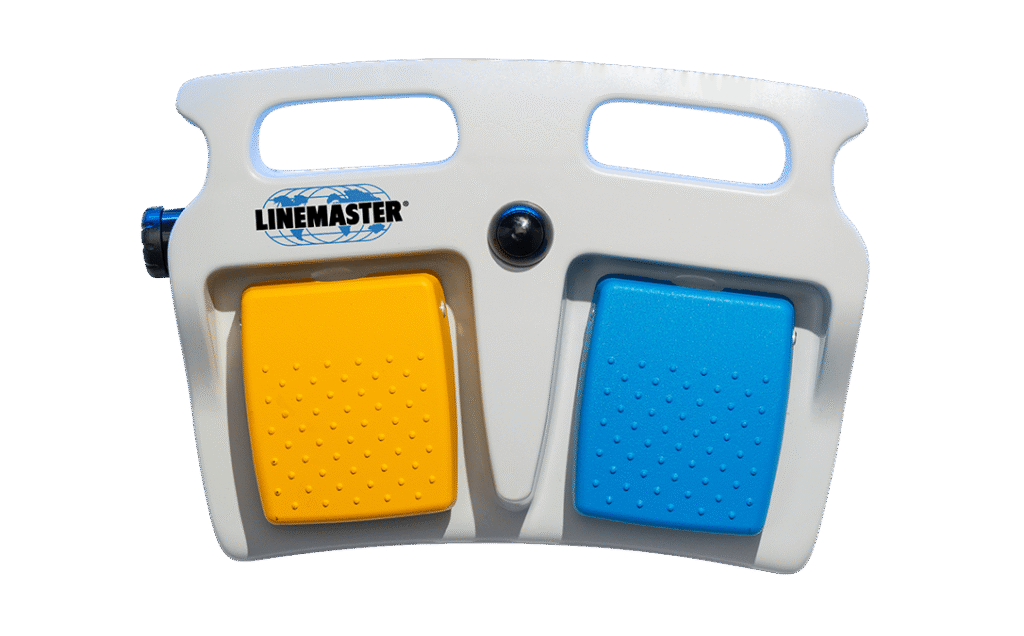
Linemaster’s current wireless product line is built on the RF platform, with models like the RF Twin Aero Wireless and the RF Hercules serving medical, industrial, and laboratory applications. These products meet IEC 60601 3rd Edition for the medical market and carry IP68 protection on the transmitter.
Bluetooth Low Energy is part of the wireless platform expansion underway at Linemaster. It sits alongside other forward-looking development areas, including secure device communication. The direction reflects how wireless control is evolving in the markets Linemaster serves.
Choosing the Right Wireless Approach
For OEMs evaluating wireless foot switch options today, RF is the platform Linemaster’s wireless products are built on, with documented performance and a long history of deployment across medical and industrial systems. For OEMs whose roadmap includes BLE integration or broader connected device ecosystems, it’s worth having a conversation with Linemaster’s engineering team about how BLE platform development aligns with that direction.
To learn more about wireless foot switch options, explore Linemaster’s wireless foot switches or reach out to the engineering team to discuss which approach fits your application.
Frequently Asked Question
What is the difference between RF, Bluetooth, and infrared wireless foot switches?
RF (radio frequency) is a closed, dedicated link between one pedal and one piece of equipment, running on a proprietary 2.4 GHz scheme that stays reliable and secure even in crowded wireless environments. Bluetooth Low Energy (BLE) is built for an open, interoperable world, designed to fit a foot switch into broader connected ecosystems alongside phones, sensors, and modern medical devices, trading a bit of power efficiency and customization for wider compatibility. Infrared transmits the signal using invisible light waves that fill a room with 360 degrees of omni-directional coverage rather than radio, relying on line of sight instead of an RF link. None is universally better; the right fit depends on the equipment, the environment, and how the foot switch fits into the larger system.
Meet The Author

Arijan Kandic
Digital Marketing Specialist
Arijan is the Digital Marketing Specialist at Linemaster Switch Corporation and holds a bachelor’s degree in business management from Quinnipiac University. He manages the company’s SEO strategy, Google Ads campaigns, and digital marketing initiatives, and develops educational content for the Linemaster Learning Center to help engineers, OEMs, and medical device manufacturers better understand foot switch technology. Arijan works closely with Linemaster’s engineering and applications teams to translate complex technical concepts into clear, accurate articles on foot switch design, customization, and compliance considerations.
In Collaboration with

William Chan
Chief Electrical Design Engineer
Bill has more than thirty four years of experience in high speed digital and analog electronic system architecture and hardware circuit design across the medical and security industries. He has been with Linemaster for over sixteen years and serves as the primary technical contact for customer electrical requirements and application specific solutions. He is best known for his wired and wireless low power digital and analog circuit designs, PCBA development, and cybersecurity focused hardware work.
Uploaded 06/04/2026
Custom Foot Switches
Linemaster’s custom footswitches are designed to meet specific user requirements, offering a range of features such as various pedal configurations, wired and wireless options, and customizable LED indicators. These custom footswitches provide reliable, durable solutions tailored to enhance functionality in diverse applications.

