
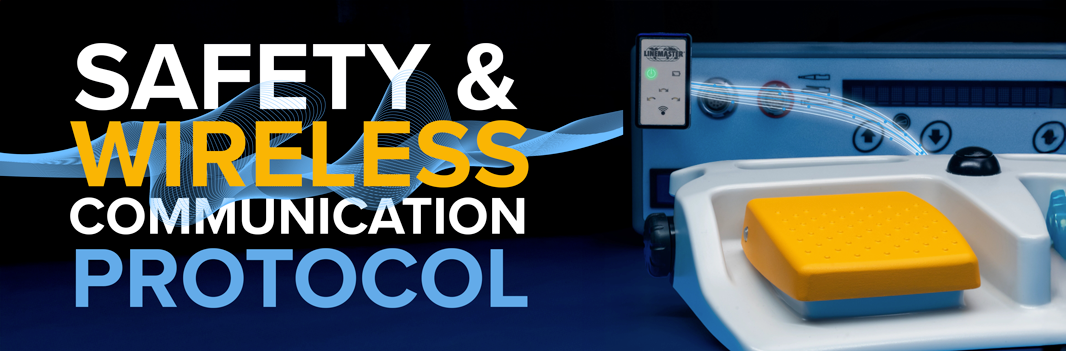
Wireless Medical Foot Switch Safety and Communication Protocol
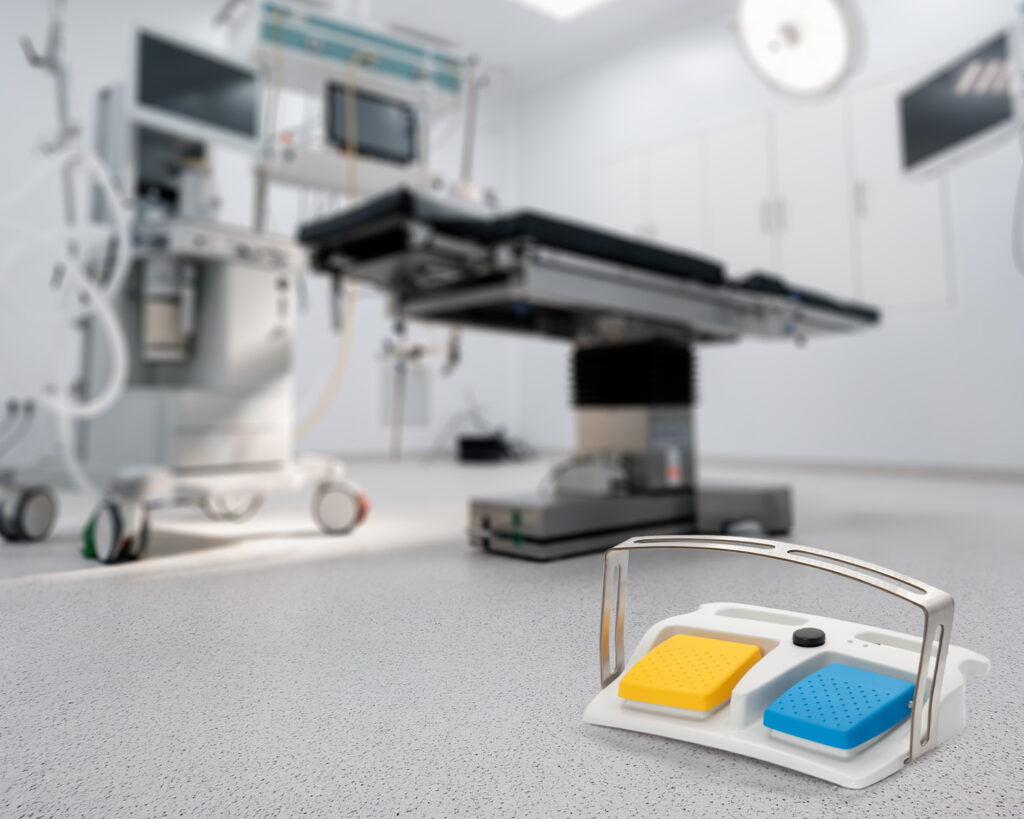
Wireless medical foot switches can help reduce cable clutter in operating rooms, which may lower trip hazards and improve mobility around surgical equipment. By eliminating a damage prone component in the assembly, the cable, wireless designs can reduce a common point of mechanical failure. By removing floor cords, staff can often reposition devices more efficiently while maintaining a cleaner workspace.
However, wireless convenience must be matched with dependable communication design. In medical environments, a foot switch signal needs to be transmitted consistently and intentionally. Systems are therefore designed to help prevent dropped signals, unintended activation, or accidental pairing with nearby equipment.
Why Pairing Security Matters in Medical Wireless Controls
Hospitals and surgical centers may have multiple wireless devices operating in nearby rooms at the same time. Without proper controls, there is a risk of a device attempting to connect to the wrong receiver or console.
To address this, wireless medical foot switch systems may use secure pairing methods that establish a dedicated relationship between the switch and its assigned receiver.

Common Wireless Pairing Safeguards
Depending on the system design, pairing protections may include:
Factory Pre Pairing
The foot switch and receiver are matched before shipment, simplifying setup and reducing configuration steps during installation.
Physical Pairing Buttons
Some systems use pairing buttons on both the foot switch and receiver. This requires intentional user interaction before a new connection can be established.
Console Initiated Pairing
Advanced systems may allow pairing through a control command or service interface, helping restrict access to authorized personnel.
NFC Based Pairing Through a Charging Cradle
Near Field Communication pairing allows a switch to reconnect with its assigned console when placed into a designated charging cradle. This approach helps reduce cross pairing risks in facilities where multiple wireless systems operate in close proximity.
Supporting Reliable Wireless Performance
Beyond pairing, medical wireless controls are engineered for dependable day to day operation through signal validation, power management, and communication protocols suited for demanding environments.
When evaluating a wireless medical foot switch, it is important to look beyond convenience and assess how the communication system supports safety, consistency, and controlled device association.
Wireless Safety Features Are Part of the Bigger Picture
Wireless communication is one component of a broader medical foot switch safety strategy that may also include redundancy, sealed construction, ergonomic actuation, and fault aware system design.
To learn more about how modern medical foot controls are engineered for safety, reliability, and performance, visit our Safety Features page.
Frequently Asked Question
Can a wireless foot switch accidentally trigger a device in a nearby operating room?
It’s a real concern in hospitals where multiple wireless devices operate close to each other, which is why wireless medical foot switches are designed with secure pairing methods that lock the switch to its assigned receiver. Depending on the system, that may include factory pre pairing, physical pairing buttons on both ends, console initiated pairing through a service interface, or NFC pairing through a charging cradle. Each method helps make sure the switch only communicates with the device it belongs to, reducing the risk of cross pairing with equipment in another room.
Meet The Author

Arijan Kandic
Digital Marketing Specialist
Arijan is the Digital Marketing Specialist at Linemaster Switch Corporation and holds a bachelor’s degree in business management from Quinnipiac University. He manages the company’s SEO strategy, Google Ads campaigns, and digital marketing initiatives, and develops educational content for the Linemaster Learning Center to help engineers, OEMs, and medical device manufacturers better understand foot switch technology. Arijan works closely with Linemaster’s engineering and applications teams to translate complex technical concepts into clear, accurate articles on foot switch design, customization, and compliance considerations.
In Collaboration with

Sean Lewis
Director of Engineering
Sean has more than fifteen years of experience in product development, engineering governance, and cross functional technical operations. His background in metal fabrication, including machining, forming, welding, and inspection, provides a strong manufacturing foundation that supports his approach to design and process optimization. Sean holds a bachelor’s degree in mechanical engineering, an MBA with a manufacturing concentration, and an MSOL. He is a Certified SolidWorks Expert with advanced capability in CAD, rendering, simulation, and rapid prototyping. Sean also specializes in DFMEA and PFMEA risk management practices and is the holder of several foot switch design and utility patents.
Uploaded 04/29/2026
Custom Foot Switches
Linemaster’s custom footswitches are designed to meet specific user requirements, offering a range of features such as various pedal configurations, wired and wireless options, and customizable LED indicators. These custom footswitches provide reliable, durable solutions tailored to enhance functionality in diverse applications.

