

Understanding Hall Sensors in Foot Switches
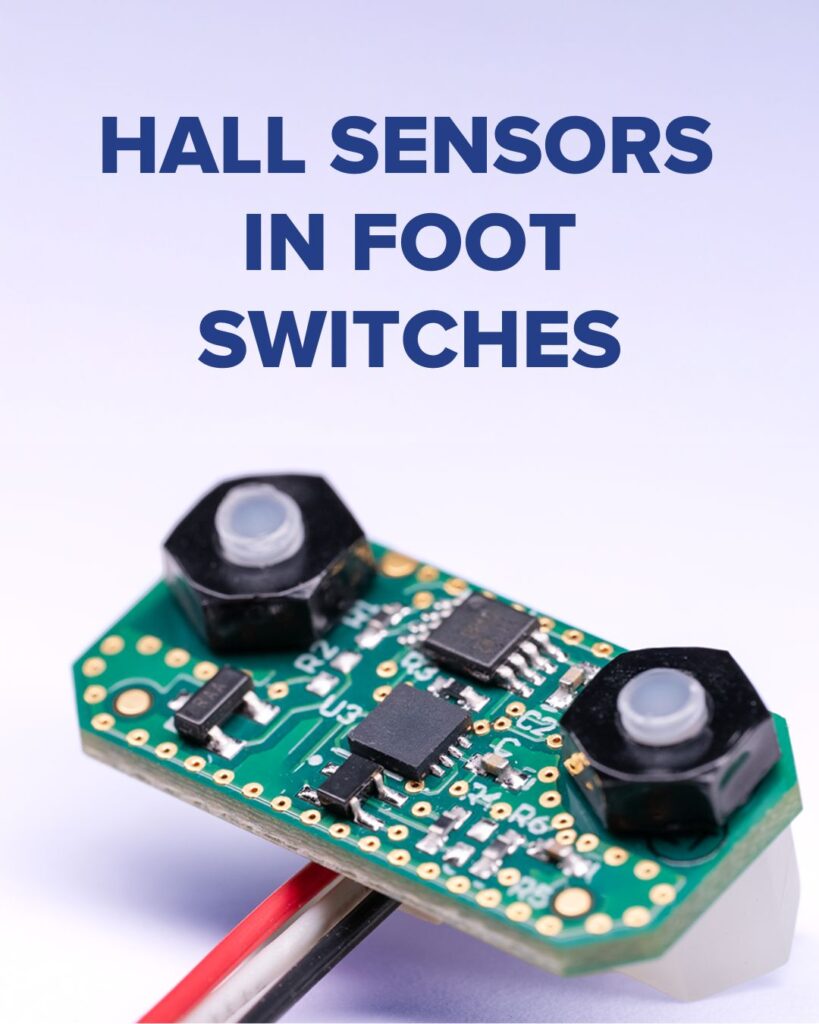
Most people don’t stop to think about how a foot switch actually knows when it’s been pressed. Inside that pedal, the sensing mechanism is what makes it work. One of the most common setups today uses something called a Hall sensor, which relies on a magnetic field to detect movement inside the treadle.
Hall sensors are known for being smooth, quiet, and accurate. That makes them a solid choice for both medical and industrial applications. They can be used for simple ON and OFF operation, for variable control that adjusts with pedal travel, or for applications that make use of both approaches. Either way, they give engineers room to fine tune how a foot switch behaves in the field.
What a Hall Sensor Does
A Hall sensor reads the position of a magnet built into the pedal. As the treadle moves, the sensor picks up the change in magnetic field and turns it into an electrical signal.
Unlike a microswitch, which gives a distinct click when it’s activated, a Hall sensor moves silently. That quiet response can be helpful in settings where the operator doesn’t need or want physical feedback.
A few quick points:
- Silent actuation with no click.
- Can be programmed for ON/OFF or variable output.
- No mechanical wear since there’s no contact point.

Using Hall Sensors for ON and OFF
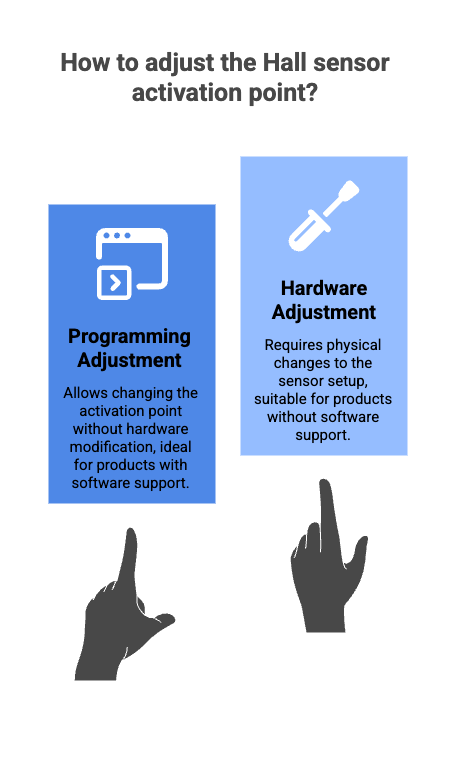
When set up for ON and OFF, a Hall sensor can be adjusted to trigger at a specific point in the treadle’s travel. The activation point can be changed through programming rather than hardware, but that adjustment is only available on products specifically designed to support it.
For example, if an operator wants the pedal to respond earlier in the stroke, that change can be made without touching the internal design. It’s a small difference that can make the pedal feel more natural in daily use.
Hall Sensors and Variable Control
The biggest advantage of Hall sensors is their ability to control outputs as the pedal moves. Instead of just switching power ON or OFF, they can deliver a signal that increases or decreases with treadle position.
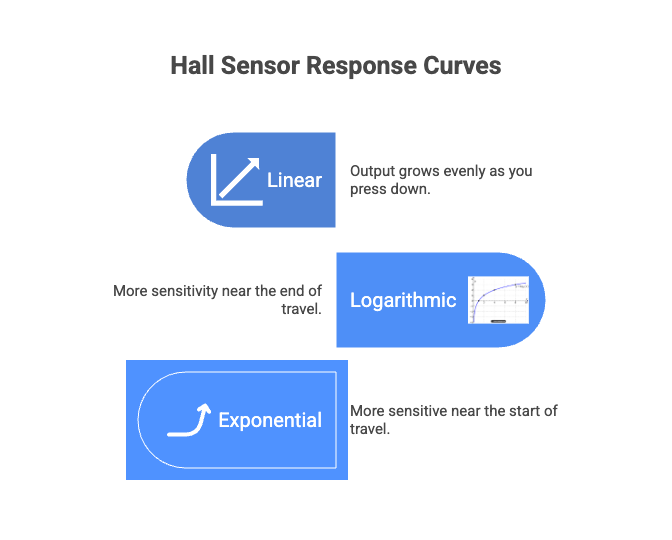
That response curve can take a few shapes:
- Linear: the output grows evenly as you press down.
- Logarithmic: more sensitivity near the start of travel.
- Exponential: faster ramp up near the end of the stroke.
These options are helpful in precise work like surgical tools, lab equipment, or industrial machines where small changes in pressure can make a big difference.
Hall Sensors, Microswitches, and Potentiometers
Each sensing method does the same basic job, but they behave differently in use.
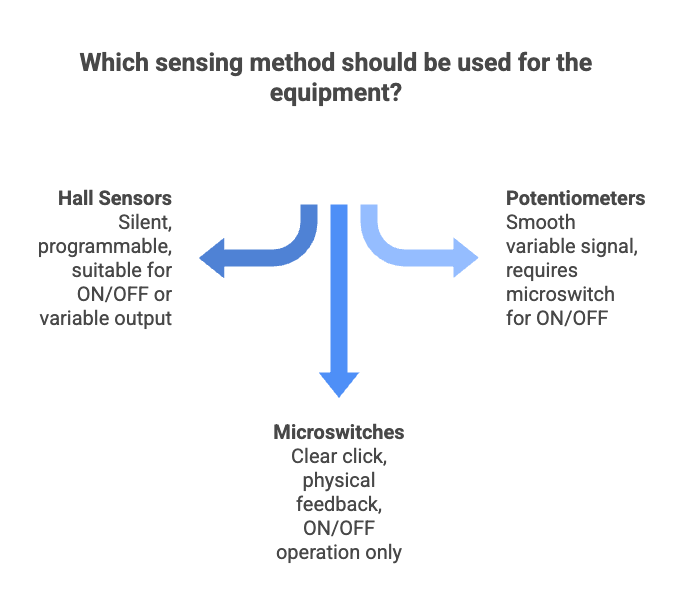
- Hall sensors are silent, programmable, and can be configured for either ON and OFF operation or variable output depending on the design.
- Microswitches offer a clear click and physical feedback, and they are used only for ON and OFF operation.
- Potentiometers provide a smooth variable signal by changing resistance as the pedal moves, but they can only be used for variable control. A microswitch must be added when an ON and OFF function is required, and finding the exact resistance value needed for a specific application can sometimes be challenging.
Since most housing can support different sensing methods, the choice usually depends on how the equipment operates and what kind of feedback or control the application requires.
When a Hall Sensor Makes Sense
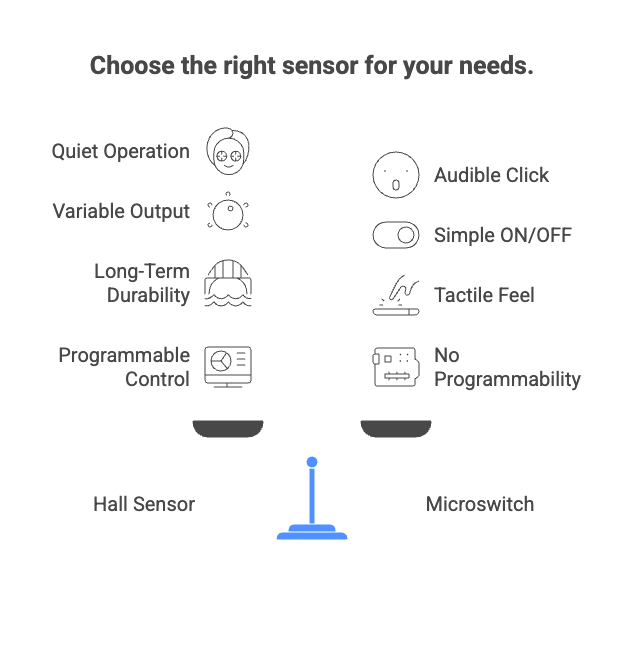
You’ll often see Hall sensors used when:
- A quiet pedal is important.
- Variable output or simple ON and OFF operation is needed.
- Long-term durability matters more than a tactile feel.
- Programmable control adds value.
If you need a clear click or audible response, a microswitch setup might still make more sense.
Final Thoughts
Hall sensors bring flexibility and precision to foot switches without adding mechanical complexity. They can run as simple ON/OFF controls or as variable systems that react to how much pressure is applied. Because there are no contact points, wear is minimal and longevity improves.
Understanding how Hall sensors differ from microswitches helps you match the sensing method to your exact application.
Call to Action
Want to learn more about sensing mechanisms and how they affect performance? Visit our Learning Center for detailed breakdowns of switch stages, flip-up covers, and other design topics. You can also explore posts on testing capabilities and ingress protection to see how durability and safety come together in our foot switches.
Meet The Author

Arijan Kandic
Digital Marketing Specialist
Arijan is the Digital Marketing Specialist at Linemaster Switch Corporation and holds a bachelor’s degree in business management from Quinnipiac University. He manages the company’s SEO strategy, Google Ads campaigns, and digital marketing initiatives, and develops educational content for the Linemaster Learning Center to help engineers, OEMs, and medical device manufacturers better understand foot switch technology. Arijan works closely with Linemaster’s engineering and applications teams to translate complex technical concepts into clear, accurate articles on foot switch design, customization, and compliance considerations.
In Collaboration with

Christian D. Smutnick
Applications Engineer
Christian has fifteen years of experience in manufacturing and three years with Linemaster. He works with customers to identify solutions that meet their technical requirements while using existing designs and components whenever possible. This supports faster lead times and cost effective options without affecting performance.
Date Uploaded 11/18/25
Custom Foot Switches
Linemaster’s custom footswitches are designed to meet specific user requirements, offering a range of features such as various pedal configurations, wired and wireless options, and customizable LED indicators. These custom footswitches provide reliable, durable solutions tailored to enhance functionality in diverse applications.

