

Understanding Foot Switch Battery Life: What Affects Performance and Longevity
When it comes to wireless foot switches, battery life often determines how reliable a product will be in everyday use. A switch that is pressed only a few times a day can last much longer than one activated for hours at a time. In the end, battery performance depends on how it is used and what the operator expects from it within their specific application.
How Wireless Foot Switches Manage Power and Battery Life
In a wireless foot switch, the processor and the communication system use the most power. The communication device, typically the radio chip that enables wireless transmission, is one of the highest power consumers in the circuit.
To conserve energy, the circuit is designed to complete its task quickly and then enter a low power sleep state for as long as possible before sending information again. This approach keeps the switch responsive while minimizing power draw.
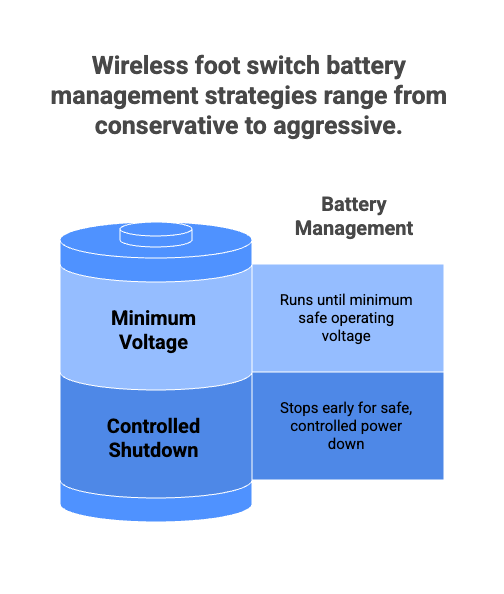
When a battery nears the end of its usable life, performance can vary depending on the application and how the customer prefers to manage it. Some operators want the switch to continue running until it reaches the minimum safe operating voltage. Others prefer it to stop earlier to allow a safe and controlled shutdown. In either case, a reliable wireless foot switch should provide a low battery warning signal so users can finish their work and replace the batteries before interruption occurs.
To confirm battery performance, engineers measure power consumption and use known battery capacities to calculate how long the switch should last. In some cases, accelerated testing is done by running several units on the same battery to estimate how a single switch would perform under typical use.
When designing for a specific application, the engineering team can calculate expected battery life based on a defined usage model that includes the number of pedal activations, average press duration, and expected frequency of use per day or week.
Battery Types and Power Options in Wireless Foot Switch Design
Different battery types are used in wireless foot switches depending on the customer’s requirements and operating environment. The most common options are rechargeable and non rechargeable batteries. Rechargeable versions require special internal hardware to allow safe charging within the device. Non rechargeable versions most often use standard alkaline AA batteries.
The choice between alkaline, lithium, or rechargeable batteries depends on available space and design goals. Rechargeable batteries often use lithium ion cells or other high density chemistries designed for compact power delivery. The internal space of the switch determines which size and configuration of battery can be integrated.
Each type of battery offers different advantages related to power density, shipping requirements, charge cycles, venting, and overall capacity. A quality manufacturer can assist in determining which option best fits the application.
Different industries tend to prefer certain battery types. Medical and laboratory environments commonly use alkaline batteries because they are easy to replace and have fewer restrictions. Industrial and consumer users often prefer lithium ion because the batteries can be recharged rather than replaced.
Charging or docking systems are designed around convenience. If the switch is returned to a charger after each use, the battery remains ready for operation. However, battery life depends on how often it is recharged. All rechargeable batteries have a limited number of charge cycles. Similar to a phone battery, performance is strongest when new but naturally changes over time. Charging within the switch may also require venting, which can affect the final IP rating or protection against water ingress.


Design Factors That Impact Wireless Foot Switch Battery Life
Balancing battery capacity with the overall size of the foot switch is one of the most important design challenges. The mechanical design team often wants the unit to be as small as possible, while the electronics team benefits from a larger battery that offers longer life. Finding the right balance ensures the design meets both performance and ergonomic goals.
Signal transmission and indicator lights affect battery performance. Lights require extra power, so a foot switch without lights lasts longer. Depending on how bright the light is, the
amount of power it takes to turn on a single light could operate at least two devices, and in some cases, even up to five.
To extend battery life, try to shut down everything as often as possible.
Batteries perform best at room temperature. Hot conditions shorten battery life, while colder temperatures can improve it. The more often the switch is activated, the faster the battery is used. Some batteries are made for high temperature environments, but they give up capacity or charge cycles in return. As the engineer explained, there is always a tradeoff, or as he put it with a catch phrase, “no free lunch.”
To simulate long term or heavy use, engineers increase the load and usage frequency during testing.

Battery Life Expectations Across Medical, Industrial, and Lab Foot Switch Applications
Battery life varies between applications. Medical switches are typically used less often, so the batteries can last a year or longer. Industrial switches are used much more heavily, so their batteries need to be charged or replaced more often.
Customers often request battery life testing to confirm performance for their application. And the results consistently align with expectations. If a power issue is identified, it’s typically traced to a specific fault or damaged component that affects energy use. Many users also expect a way to monitor battery status. Some prefer to see the voltage level so they can decide when to replace the battery. While others want a simple low battery indicator or an early warning, such as a one month notice or a flag when a set number of hours remain. Because reminders are sometimes overlooked, systems are designed with a built in margin to ensure safe operation even if a warning is ignored. As a standard practice, batteries are replaced at regular intervals to maintain reliable performance and minimize the chance of downtime.
When the battery runs low, the electronics should shut down safely and stop drawing power. This prevents issues and protects the battery. Rechargeable batteries must stop before they’re fully drained to avoid damage. While non rechargeable batteries can be used until fully depleted and then replaced.

The Future of Wireless Foot Switch Battery Performance
Advancements in technology continue to improve battery performance. The electronics draw less power than before, and newer processors are more efficient. The design also takes advantage of usage patterns that keep the circuit powered off as often as possible to save energy.
Battery designs themselves are getting better and last longer.
Customer feedback often shapes design improvements. In some cases, it leads to larger enclosures that make room for additional or higher capacity batteries. Even with those adjustments, design teams always balance space, performance, and safety to reach the best overall solution for the application.

Closing Thoughts
Battery life depends on design, usage, and expectation. Whether it’s a rechargeable lithium ion setup, or a standard alkaline battery used occasionally, understanding how power is consumed helps ensure each foot switch performs as intended.
If you’d like to explore the right wireless foot switch setup for your application, contact Linemaster’s team to discuss your requirements.
Frequently Asked Question
What happens to a wireless foot switch if the battery dies mid-procedure?
A reliable wireless foot switch is designed to give a low battery warning signal well before the battery actually dies, so users can finish their work and replace the batteries before any interruption occurs. Systems also include a built in margin in case the warning is overlooked. When the battery does reach the end of its usable life, the electronics shut down safely and stop drawing power, which protects the battery and prevents unexpected behavior. Replacing batteries at regular intervals is a standard practice for keeping performance consistent and reducing the chance of downtime.
Meet The Author

Arijan Kandic
Digital Marketing Specialist
Arijan is the Digital Marketing Specialist at Linemaster Switch Corporation and holds a bachelor’s degree in business management from Quinnipiac University. He manages the company’s SEO strategy, Google Ads campaigns, and digital marketing initiatives, and develops educational content for the Linemaster Learning Center to help engineers, OEMs, and medical device manufacturers better understand foot switch technology. Arijan works closely with Linemaster’s engineering and applications teams to translate complex technical concepts into clear, accurate articles on foot switch design, customization, and compliance considerations.
In Collaboration with

William Chan
Chief Electrical Design Engineer
Bill has more than thirty four years of experience in high speed digital and analog electronic system architecture and hardware circuit design across the medical and security industries. He has been with Linemaster for over sixteen years and serves as the primary technical contact for customer electrical requirements and application specific solutions. He is best known for his wired and wireless low power digital and analog circuit designs, PCBA development, and cybersecurity focused hardware work.
Date Uploaded 11/12/25
Custom Foot Switches
Linemaster’s custom footswitches are designed to meet specific user requirements, offering a range of features such as various pedal configurations, wired and wireless options, and customizable LED indicators. These custom footswitches provide reliable, durable solutions tailored to enhance functionality in diverse applications.


