
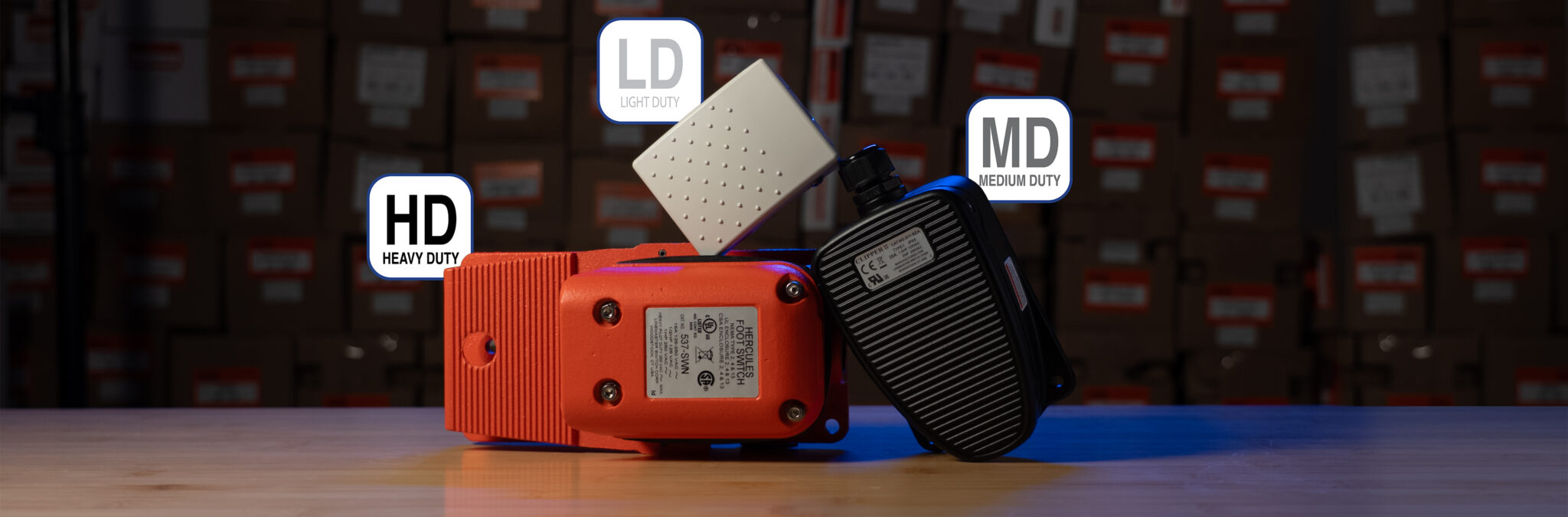
What Heavy, Medium, and Light Duty Really Mean in Foot Switch Design
Heavy, medium, and light duty in foot switches are not standardized engineering specifications. In foot-switch design, duty is an internal classification used to estimate how a switch will perform over time based on its use, frequency, and operating environment. Without that context, the duty label alone can easily be misunderstood.
What follows explains how engineers actually think about duty in foot switches, what it represents, and how these classifications translate into real-world use.
These duty classifications apply specifically to our industrial product line and are not industry standards. Light, medium, and heavy duty are internal categories used to describe how a foot switch is expected to perform over time, based on construction and use in demanding industrial environments, and often feature thicker housings, higher-strength materials, and protective features such as built-in guards. While electrical ratings are determined by the internal microswitch and are not tied to duty, heavy-duty products are more commonly paired with higher electrical load applications.
In practical terms, heavy-duty foot switches are often found on large industrial equipment, such as press brakes, welding equipment, and other machinery, where durability and resistance to physical abuse are priorities. Light-duty switches are more commonly used on lab equipment or light manufacturing tools, where portability and lower weight matter more than impact resistance. Medium-duty designs fall between these extremes, balancing durability, stability, and cost. Understanding how the switch will be used, moved, and interacted with by the operator is more important than the duty label alone.
Why Duty is Often Misunderstood?
When customers describe a foot switch as light, medium, or heavy duty, they are usually trying to communicate how demanding their application is. They often think about durability, longevity, or whether a switch will hold up in their specific environment.
From an engineering standpoint, duty is not based on a fixed formula or a single measurable value. It is assigned internally and is influenced by multiple factors, including the switch’s robustness, the materials used, material thickness, and ingress protection considerations.
Problems can arise when the duty is assumed incorrectly early in a project. Selecting a switch that is too light for the application can lead to issues such as housing deformation from impact, insufficient protection from environmental exposure, or reduced service life. Choosing a heavier-duty switch than necessary can increase cost and weight and may reduce portability when mobility is important.

What Duty Means in Foot Switch Design?
From an engineering perspective, duty is assigned after evaluating what customers are looking for in a switch. This includes whether the switch needs to be stable and difficult to move, or lightweight and easy to transport between locations. Environmental exposure also plays a role, such as whether a higher ingress protection level is required or if a lower splash rating is sufficient.
Core factors used to classify duty include material selection, ingress protection rating, and material thickness. While expected usage frequency is often assumed to drive duty, mechanical cycle ratings are largely consistent across designs. Most switches are mechanically rated to the same cycle count. The difference lies in the environments in which those cycles are expected to occur.
It is also important to clarify what duty does not account for. Duty classification does not reflect electrical ratings. A light-duty switch can still be rated for high voltage, current, or horsepower depending on the internal microswitch.

Understanding Light Duty Foot Switches
Light-duty foot switches are typically associated with thin-sheet-metal housings or plastic construction. These designs are commonly used in office environments or light manufacturing settings.
In terms of performance and service life expectations, light-duty designs are consistent when used in appropriate applications.
Understanding Medium Duty Foot Switches
Medium-duty foot switches differ from light-duty designs primarily in construction. Instead of plastic housings, medium-duty designs often use cast zinc or cast alloy materials.
Medium duty is commonly selected as a middle ground option, balancing construction, weight, and cost. These designs provide greater stability on the floor than lighter constructions, without the cost typically associated with heavier designs.
From an application standpoint, medium-duty switches are often used in medical environments, such as table controls for medical beds in doctors’ offices. In other cases, medium-duty designs are selected to reduce the need for frequent replacement over time.


Understanding Heavy Duty Foot Switches
Heavy-duty foot switches are characterized by thicker construction and higher-strength materials. These designs often use cast iron, cast aluminum alloys, or steel and are inherently heavier.
Housing design and material selection play a key role in heavy-duty classification. Thicker materials and higher-strength metals are used to support applications where durability is a priority. While some heavy-duty designs include higher ingress protection levels, heavier duty does not automatically mean better sealing. In some cases, additional gasketing or sealing methods are used depending on the application.
Heavy-duty switches are typically selected for construction durability rather than electrical load requirements. Electrical ratings are not tied to duty classification. The primary tradeoffs when selecting a heavy-duty design are increased cost and weight.
Engineering Considerations When Selecting a Duty Rating
When determining the appropriate duty level, engineers rely heavily on environmental assumptions. Certain applications naturally point toward a heavier-duty selection, while others may fall into light or medium duty depending on longevity expectations.
A common misconception is that duty ratings are tied to a precise formula. In reality, duty is a broad category used to help guide selection based on application needs and operating environment.
Selecting a level higher than necessary can affect usability by adding weight, which may matter when a switch needs to be moved or repositioned. Selecting a duty level that is too light can affect service life, leading to more frequent replacement over time.
Stability requirements also influence duty decisions. Since mechanical cycle ratings are consistent, how solidly a switch needs to stay in place can become more important than raw actuation counts.
How Duty Ratings Translate to Real World Applications
There are many situations where more than one duty level could be appropriate. In these cases, selection often comes down to how frequently a switch is expected to be replaced over time.
System integration also plays a role. In medical applications, for example, a switch may need to be stable on the floor during use while remaining light enough to be picked up and placed on a console or hung when not in use. These practical considerations can influence which duty level makes the most sense for a given application.
Key Takeaways about Duty Ratings
Duty is an estimate used to help determine which foot switch makes sense for a given application. It is based on what is important to the user and the environment in which the switch will be used.
Clarifying duty expectations early can extend service life by ensuring all relevant information is considered from the outset.
If you are unsure which duty level makes sense for your application, taking the foot switch quiz on our website can help narrow down the most suitable options.

Meet The Author

Arijan Kandic
Digital Marketing Specialist
Arijan is the Digital Marketing Specialist at Linemaster Switch Corporation and holds a bachelor’s degree in business management from Quinnipiac University. He manages the company’s SEO strategy, Google Ads campaigns, and digital marketing initiatives, and develops educational content for the Linemaster Learning Center to help engineers, OEMs, and medical device manufacturers better understand foot switch technology. Arijan works closely with Linemaster’s engineering and applications teams to translate complex technical concepts into clear, accurate articles on foot switch design, customization, and compliance considerations.
In Collaboration with

Sean Lewis
Director of Engineering
Sean has more than fifteen years of experience in product development, engineering governance, and cross functional technical operations. His background in metal fabrication, including machining, forming, welding, and inspection, provides a strong manufacturing foundation that supports his approach to design and process optimization. Sean holds a bachelor’s degree in mechanical engineering, an MBA with a manufacturing concentration, and an MSOL. He is a Certified SolidWorks Expert with advanced capability in CAD, rendering, simulation, and rapid prototyping. Sean also specializes in DFMEA and PFMEA risk management practices and is the holder of several foot switch design and utility patents.

Christian D. Smutnick
Applications Engineer
Christian has fifteen years of experience in manufacturing and three years with Linemaster. He works with customers to identify solutions that meet their technical requirements while using existing designs and components whenever possible. This supports faster lead times and cost effective options without affecting performance.
Date Uploaded 02/18/26
Custom Foot Switches
Linemaster’s custom footswitches are designed to meet specific user requirements, offering a range of features such as various pedal configurations, wired and wireless options, and customizable LED indicators. These custom footswitches provide reliable, durable solutions tailored to enhance functionality in diverse applications.

