

How Fault Detection Works in a Foot Switch System
Foot switches look simple from the outside. A pedal, a cord, an output. But inside any switch built for medical, lab, or industrial use, there is a whole layer of electrical design dedicated to one job: catching a problem before it turns into one. That layer is fault detection, and the more critical the application, the more it matters.
Here is a closer look at how fault detection actually works inside a foot switch system, what it watches for, and where the real engineering tradeoffs show up.
What Fault Detection Actually Means
At the electrical design level, fault detection comes down to a simple structure. For each fault condition the system needs to catch, there is a sensor watching for it and a fast reaction mechanism that can shut the output down if something goes wrong. When a fault is isolated to a single input, the response can be scoped to match. Either only the affected output gets disabled, or all outputs do, depending on how the application is built.
That is the core idea. Everything else is a question of which faults are worth detecting, how to detect them reliably, and how the system should behave once it does.
The Faults a Foot Switch Watches For
Modern foot switches deal with a long list of possible fault conditions, and wireless models add even more to the list. ESD events, reverse battery installation, and low battery are common watch points on wireless designs. Over or under voltage and current, abnormal switch orientation, and processor faults sit on the broader hardwire side. Pedal sensors get their own attention, with the system flagging any time a linear sensor reads outside its normal range, or stays inside the range but lands higher or lower than expected. There is also the case of a switch output stuck on or stuck off, and data corruption that triggers an output to activate or deactivate without any actual input.
Out of all of these, the most critical category is anything that can cause inadvertent activation or deactivation of an output. A lot of the conditions above can lead there if they go unchecked, which is why the design treats them as the top priority.
How Supervised Circuits Keep Watch
A supervised circuit is the workhorse of foot switch fault detection. It sits in the background, continuously checks for expected conditions, and automatically disables the output the moment something falls outside those conditions.
The interesting part is how a fault gets handled. A supervisor can be set to latch the fault or not. A latched response holds the output off until the system is power cycled or until a specific clear command comes through, even if the fault has come and gone. An unlatched response only holds the output off for as long as the fault is actually present. Which one to use depends on the equipment and how much acknowledgement the application calls for.
End of line resistors come into play whenever the system needs to verify not just that a piece of equipment is connected, but what kind of equipment is connected. A small resistor placed at the end of a signal line gives the sensing side something measurable. A 100-ohm resistor might identify equipment A. A 1000-ohm resistor might identify equipment B. And so on. The number of recognized types is essentially limited by how accurately the sensing scheme can measure resistance, bias voltage, or bias current. That is a lot of flexibility for such a small component.
Microswitch Design vs. Hall Effect Designs
The way fault detection works depends heavily on what type of sensor sits inside the foot switch. Microswitches and Hall effect sensors handle the job in very different ways, and each comes with its own challenges.
A microswitch only reports two states: ON or OFF. Both states are valid, so on its own there is no way to tell whether the switch is in the wrong state. This is where a second redundant switch comes in. with two switches attached to the same pedal, both have to agree on the state for the reading to count. Any mismatch flags an error.
There is one wrinkle. If both switches end up shorted together because of a fault, they will always report the same state, and the redundancy disappears. To get around that, the second switch is wired with opposite polarity. In a healthy system, the two switches always read opposite value during activation and deactivation. The moment they read the same, the system knows something is wrong.
Hall effect and other linear sensors work differently. Instead of two discrete states, they output a continuous voltage range. Anything outside the expected range, which is set during factory calibration and stored in nonvolatile memory, is treated as a fault.
The harder case with linear sensors is a fault that lands inside the expected range. If a sensor gets stuck at a voltage that happens to fall between the minimum and maximum, the system has no way to tell that apart from a user simply holding the pedal at the position. That kind of fault is generally undetectable on its own. The fix is the same as it is for microswitches: add a second sensor. Both have to agree for the measurement to count, and the second sensor needs to output a value that differs from the first at all times, so a short between the two can be caught.
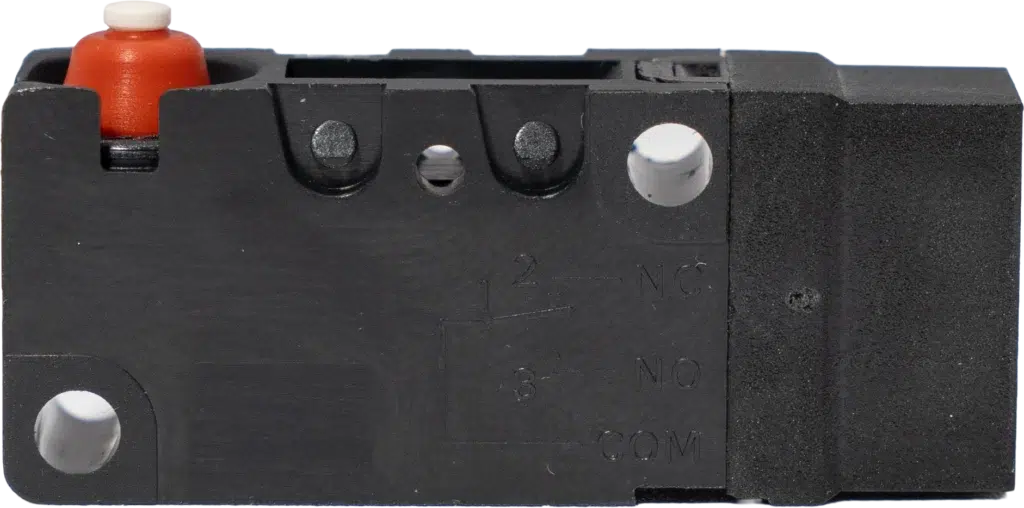
Microswitch
VS.
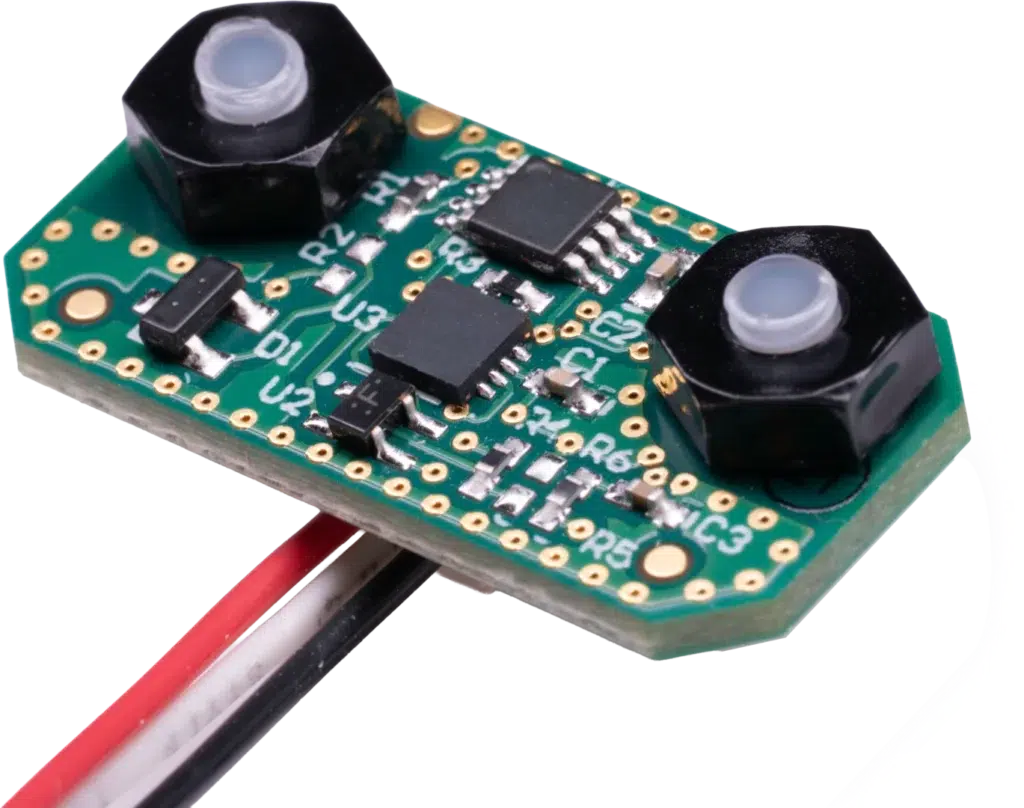
Hall Sensor
Why Redundancy Matters
The pattern that runs through both sensor types is redundancy. A single sensor can only tell the system so much. Two sensors, designed to disagree in predictable ways, can either confirm each other or reveal a problem. When the two channels disagree, the system has a clear signal that something is off, and the response is dictated by the application. Sometimes only the affected output is shut down. Sometimes everything is.
That choice is part of the design conversation early on, because the right response in a high stakes medical application is not always the right response in a more forgiving industrial setting.

What Happens When a Fault Is Detected
From an electrical standpoint, the response is fast and direct. The output corresponding to that input is shut off immediately, and the fault is announced through whatever interface the equipment provides. Whether the equipment surfaces that to a user, logs it, or triggers a specific recovery sequence is up to the host system.
The safe state for a foot switch in this scenario is straightforward. The output is disabled. No partial activation, no held state, no ambiguity.
The Real Mistakes and Misreads
The most common misunderstanding around foot switch fault detection is treating every flagged condition as a real fault. A lot of conditions look like faults at first glance, but are actually side effects of how a sensor responds to its environments.
Accelerometers are a good example. They constantly pick up vibrations during normal use, not because the foot switch is being titled, but because the equipment around it is moving. Without filtering or debouncing, those readings can trigger orientation faults that have nothing to do with an actual problem.
Mechanical switches have their own version of this. Two redundant switches almost never activate at the exact same instant. There is a brief moment during the transition where they disagree, simply because one is a fraction of a second ahead of the other. Equipment that latches faults without debouncing will capture that as a fault every time, even though it is part of normal operation as long as the mismatch lasts no longer than a defined window.
The takeaway is that fault detection is not just about catching errors. It is about telling real errors apart from the noise that any physical system produces.
When Fault Detection Earns Its Keep
There is a story that captures why this all matters. A foot switch in a surgical environment was flagged by its fault detection system before a procedure even started, giving the medical team time to swap it out before the patient was on the table. If the fault had not been caught until the middle of the procedure, the switch would have shut itself down immediately to prevent any unintended output. Either way, the system did its job. But catching it early was the difference between a quick equipment swap and a real disruption during surgery.
That is the quiet value of good fault detection. Most of the time, it does its work without anyone noticing. When it matters, it matters a lot.
Looking Ahead
Fault detection is one of those design areas where the right approach depends as much on the application as it does on the sensors. Medical, industrial, and lab environments all have different tolerances for false positives, latched responses, and recovery behavior, and the supporting circuit design has to reflect that.
If you are working on a project where the foot switch needs to do more than just close a contact, fault detection is one of the conversations worth having early. It tends to shape decisions about sensor type, channel count, and how the whole system handles an unexpected moment far better than retrofitting it later.
If that sounds like the stage you are at, our engineering team is always open to a conversation about what fault detection should look like for your application. Reach out through the contact page and we can take it from there.
Meet The Author

Arijan Kandic
Digital Marketing Specialist
Arijan is the Digital Marketing Specialist at Linemaster Switch Corporation and holds a bachelor’s degree in business management from Quinnipiac University. He manages the company’s SEO strategy, Google Ads campaigns, and digital marketing initiatives, and develops educational content for the Linemaster Learning Center to help engineers, OEMs, and medical device manufacturers better understand foot switch technology. Arijan works closely with Linemaster’s engineering and applications teams to translate complex technical concepts into clear, accurate articles on foot switch design, customization, and compliance considerations.
In Collaboration with

William Chan
Chief Electrical Design Engineer
Bill has more than thirty four years of experience in high speed digital and analog electronic system architecture and hardware circuit design across the medical and security industries. He has been with Linemaster for over sixteen years and serves as the primary technical contact for customer electrical requirements and application specific solutions. He is best known for his wired and wireless low power digital and analog circuit designs, PCBA development, and cybersecurity focused hardware work.
Uploaded 05/14/2026
Custom Foot Switches
Linemaster’s custom footswitches are designed to meet specific user requirements, offering a range of features such as various pedal configurations, wired and wireless options, and customizable LED indicators. These custom footswitches provide reliable, durable solutions tailored to enhance functionality in diverse applications.

